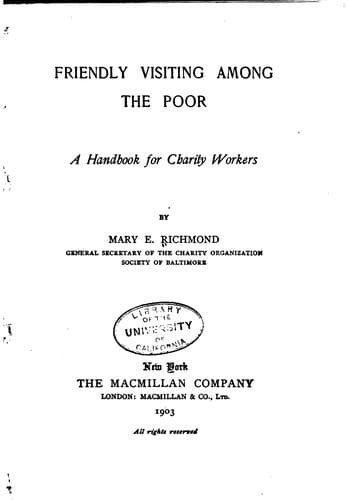
Friendly Visiting among the Poor: A Handbook for Charity Workers — John Shaqi
Friendly Visiting among the Poor: A Handbook for Charity WorkersRichmond, Mary Ellen
General
Friendly Visiting among the Poor: A Handbook for Charity Workers
Richmond, Mary Ellen
Friendly visiting
In turning to the details of family life among the poor, I take the
breadwinner, or the one who ought to be the breadwinner, as my first
consideration for the reason that he is so often ignored altogether by
charity workers. Especially is this true of church workers. "A church
worker came to me the other day," writes Mrs. Bosanquet, "about a
family of little children, concerning whom he was greatly distressed.
He had visited them for months, and found the woman honest, striving,
and clean, but _as usually happens_ he knew very little of the man. He
assured me {19} over and over again that the family was in a pitiable
state of poverty and in urgent need of help; and we at once set to work
to ascertain the real financial position. Result: man earning 35s.,
giving 20s. to his wife and keeping 15s. for pocket-money. Obviously,
if charity steps in here, it will not necessarily improve the state of
the wife and children at all; it will merely enable the man to keep a
still larger proportion of his wages for pocket-money." [1]
But, though the charity worker may ignore the man of the family, there
are others who are wiser. In the first place he is a voter, and the
ward-worker, the policeman, and the saloon-keeper never forget this
fact.
An illustration of the policeman's interest in the voter as an
applicant for charity may be found wherever the police are allowed to
become distributors of alms. In Baltimore the police have been allowed
to distribute relief intrusted to them by private citizens, and have
been in the habit of making public appeals for such contributions to
aid the poor {20} in cold weather. One policeman, who had a difficult
beat, where there were many toughs and criminals, said that the
distribution of police relief made his work easier, as toughs whose
families had been relieved did not trouble him so much. It is an
interesting fact that, during the hard times of 1893-94, political
clubs vied with each other the country over in distributing aid.
Leaders of Tammany Hall were shrewd enough to urge their followers to
organize relief distributions in every district of New York.
Public-domain text, read in full here on John Shaqi.
Reviews
Reviews
No reviews yet
Be the first to share your thoughts on this work.
Join the Discussion
Join the discussion
Sign in to leave a comment or review.
Sign InorCreate an account