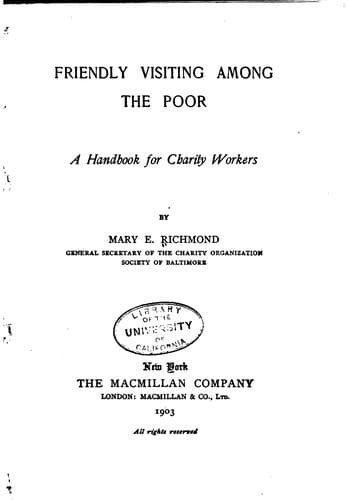
Friendly Visiting among the Poor: A Handbook for Charity WorkersRichmond, Mary Ellen
General
Friendly Visiting among the Poor: A Handbook for Charity Workers
Richmond, Mary Ellen
Friendly visiting
There are many charitable visitors to whom the very thought of strong
drink is so offensive, to whom everything connected with the saloon
seems so brutal and degraded, that they are unable to make allowance
for national, neighborhood, and family traditions in judging a man's
habits. It sometimes happens that a whole family are condemned as
"frauds" because they drink beer for dinner, or because the man of the
house has been seen to enter a saloon. On no subject, perhaps, are
charity workers so divided as on the question of how best to deal with
the drink evil. Here, if anywhere, fanaticism is excusable, perhaps;
but here, as everywhere, the friendly visitor must be on guard against
personal prejudice and a hasty jumping at conclusions. "At night all
cats are gray," says the old proverb, and it is only the benighted
social reformer that thinks of all who drink as drunkards, and of all
places where liquor is sold as dens of vice. The saloon is still the
workingman's {58} club, and, until some satisfactory substitute is
found for it, all our denunciations will fail to banish it. It is none
the less true that, of all personal habits, the drink habit stands next
to licentiousness as a cause of poverty and degeneration.
"The problem of intemperance meets us in less than half the families
that we know," says the Secretary of the Boston Associated Charities,
"but it is that half which gives us the most concern. There are many
ways of dealing with the drunkards and with their families, and the
remedy must be separately chosen for each case. Some of our friends
are impatient with all these partial remedies and will use none of
them, waiting until they can sweep out of the State the alcohol which
seems to them the whole cause of the trouble. But if it were all taken
away to-morrow, I feel sure we should find this also only a partial
remedy, and that the same want of self-control which makes men and
women drunkards would drive some of them to-morrow to other and perhaps
worse stimulants. So, while I hope and believe that slowly and
steadily the sentiment of individuals {59} is growing toward total
abstinence, and that in the course of years, generations, perhaps, it
will become the law of the State, I believe in working man to man and
woman to woman in building up and strengthening character as the chief
safeguard against so great an evil." [7]
Public-domain text, read in full here on John Shaqi.
Reviews
Reviews
No reviews yet
Be the first to share your thoughts on this work.
Join the Discussion
Join the discussion
Sign in to leave a comment or review.
Sign InorCreate an account