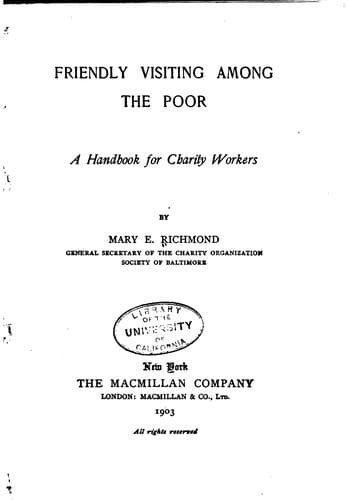
Friendly Visiting among the Poor: A Handbook for Charity WorkersRichmond, Mary Ellen
General
Friendly Visiting among the Poor: A Handbook for Charity Workers
Richmond, Mary Ellen
Friendly visiting
There are many causes of the drink evil, as I have tried to show, but,
after every allowance has been made, the chief cause will often be
found in the selfishness of the human heart. {62} There are men who do
not care to be cured of drunkenness, who feel no shame for the misery
and degradation brought upon their families. Here again the "sad fact
of incurability" must be recognized. It is folly to let such men
discover that, through our charitable interest in their families, we
will either directly or indirectly pay their whiskey bills, or will
assume the burdens that they deliberately shirk. A Committee on
Intemperance, reporting to the Ward VIII. Conference of the Boston
Associated Charities in 1886, called attention to this aspect of the
question. "The committee, however, say that, in their opinion, the
question of moral responsibility on the part of the intemperate, and
also, in its degree, on the part of those who, by gifts or other aid,
make intemperance easy, is too much lost sight of; and they believe
that the refusal of all aid to the families of drunkards, outside the
almshouse, unless in exceptional cases, would bring about a better
state of opinion and a juster sense of responsibility. The committee
add that it will be almost impossible to make kind-hearted people
believe this, since they are more moved {63} by the sight of present
suffering than by the hope of future permanent improvement, to secure
which some measure of present suffering may be necessary." [9]
Collateral Readings: "An Adventure in Philanthropy," Edwin C. Martin in
"Scribner's," Vol. XI, pp. 230 _sq_. "Charity and Home Making," the
present writer in "Charities Review," Vol. VI, No. 2. "Married
Vagabonds," the same, in Proceedings of Twenty-second National
Conference of Charities, pp. 514 _sq_. "Drunkards' Families," Rev. W.
F. Slocum in Proceedings of Fifteenth National Conference of Charities,
pp. 131 _sq_. "The Social Value of the Saloon," E. C. Moore in
"American Journal of Sociology," Vol. III, No. 1. "Substitutes for the
Saloon," F. G. Peabody in "Forum" for July, 1896. "Law and Drink,"
Frederick H. Wines in "Charities Review," Vol. VII, Nos. 3 and 4.
[1] "Rich and Poor," p. 105.
[2] pp. 72 _sq_.
[3] "Charities Review," Vol. VI, pp. 121 _sq_.
[4] See Proceedings of the Twenty-second National Conference of
Charities and Correction, New Haven, 1895, pp. 514 _sq_.
[5] "Public Relief and Private Charity," p. 105.
[6] See on this subject the Proceedings of the Twenty-fourth National
Conference of Charities and Correction at Toronto, 1897, pp. 5 _sq_.
[7] Miss Z. D. Smith in Report of Union Relief Association of
Springfield, Mass., 1887.
[8] "Charities Record," Baltimore, Vol. I, No. 1.
[9] Seventh Report of Boston Associated Charities, p. 39.
{64}
CHAPTER IV
THE HOMEMAKER
Public-domain text, read in full here on John Shaqi.
Reviews
Reviews
No reviews yet
Be the first to share your thoughts on this work.
Join the Discussion
Join the discussion
Sign in to leave a comment or review.
Sign InorCreate an account