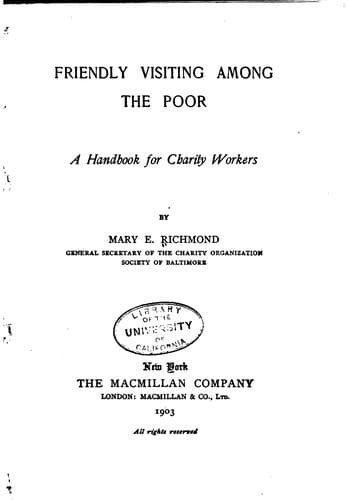
Friendly Visiting among the Poor: A Handbook for Charity WorkersRichmond, Mary Ellen
General
Friendly Visiting among the Poor: A Handbook for Charity Workers
Richmond, Mary Ellen
Friendly visiting
The wife brings us to another aspect of the home, though it cannot be
too often repeated that all aspects are so inextricably interwoven that
they must be considered together. When the wife takes the means
provided, the raw material from which a home is to be made, she engages
in a very complicated form of manufacture, including in its processes
the buying, preparation, and serving of food, the care of the household
possessions, the buying, making, and care of clothing, the training of
children, and many minor departments. These are only processes,
however, and, unless the maker have an ideal picture in her mind of
what a home should be, neither some nor all of these processes will
make a home.
In dealing with the homemaker, the friendly visitor becomes more
directly a teacher, though {65} it is often necessary that she should
first be a learner. The agent of a New York charity tells of a
friendly visitor who was consulted by the agent about a family applying
for relief. They were found to have an income of $20.00 a week.
"Well," said the visitor, "that is very little money on which to raise
a family." The agent felt that this visitor had not only a great deal
to learn, but a great deal to unlearn.
Not every visitor is skilled in buying and preparing food, or in
arranging a household budget, and the visitor that is skilful in doing
this on one scale of expenditure may be quite ignorant and helpless in
dealing with another and much smaller scale. One who is really in
earnest, however, in the desire to help another, will never give up
because there are difficulties to overcome. The visitor may not know,
but as compared with the homemaker in a poor family, has far more time
and a greater facility, perhaps, in learning. The visitor's best
teachers are friends that have had experience, and the poor themselves.
One can learn a great deal from the more frugal and industrious of the
very poor, and these are proud to explain {66} their small economies,
when our reasons for wishing to learn are made clear to them.
Lacking these teachers, there are books, though books have the
disadvantage of never meeting the needs of any one locality.
Variations of climate, custom, and the local markets make specific
suggestions about buying difficult. For this reason I shall not
attempt to go into detail, but suggest that, as our relations with our
poor friends should be as natural as possible, when we do not know
anything, it is always best to frankly say so, and then think out with
them some way of learning. For instance, it would be natural enough
for a visitor to say to the homemaker: "We both feel that there is a
lot to learn about the best way of buying and preparing food. I have
an acquaintance that has made a study of the subject, and, with your
permission, I am going to bring her here, to give us both some
suggestions."
Public-domain text, read in full here on John Shaqi.
Reviews
Reviews
No reviews yet
Be the first to share your thoughts on this work.
Join the Discussion
Join the discussion
Sign in to leave a comment or review.
Sign InorCreate an account