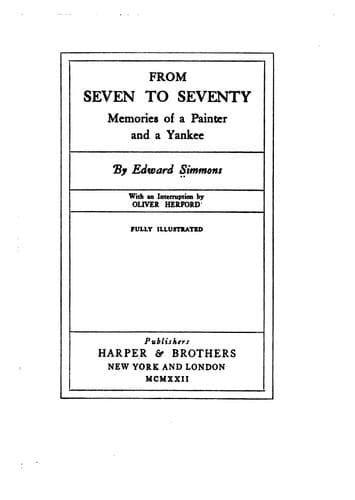
From Seven to Seventy: Memories of a Painter and a YankeeSimmons, Edward
General
From Seven to Seventy: Memories of a Painter and a Yankee
Simmons, Edward
Artists -- Biography
You must be the type who trusts your friends by doing (while
blindfolded) anything that he swears on his honor he has done before
you, but if it is proven that that friend has deliberately gone back on
you, you must show that you resent it. For example, my anger at Ned was
pardoned; but a son of one of the generals in the Civil War went through
all the requirements until he refused to put on some article of clothing
which seemed to him filthy (his eyes being bandaged), in spite of the
fact that all of the others swore they had gone through the same
experience without harm. He never became a member of the Hasty Pudding
Club.
One of the requirements is an essay which is taken very seriously by the
patient neophyte, but is really of no importance. Mine, on the subject
of “Public Insane Asylums vs. Private Mad Houses,” was never read, for
the reason that it was stolen by a ring within the club who called
themselves “Owls of the Night” and thought it very funny to reduce the
size of the new man’s head by destroying his work whenever possible. I
was sure I had hidden my essay where no one would find it—in the bottom
of the spittoon, covered with layers of newspapers, then melted candle
grease, and lastly, the remaining space filled with water and cigar
butts. But my roommate told; and I had to lie, when asked for it, so as
not to go back on the gang.
One of the most interesting possessions of the club was the Crocodile
Book, or the record kept by the secretary since the beginning. At the
end of one of the chapters was a charming drawing by Washington Allston,
of a fat boy gobbling mush from a pot. I used to stare at this and
wonder about the man who did it. Alas! when I went back, some twenty
years later, there was no trace of the drawing and no one could be found
who had ever heard of it.
These acts of vandalism are found more often among the educated classes
than otherwise. I often think of the clergyman who was found with a
hammer in his hand, having just knocked a piece off a tomb in
Westminster Abbey, which dated back to the days of Edward the
Confessor—the only one that had never been cracked or harmed! The judge
very wisely did not punish him, but left him to the tender mercies of
the newspaper reporters. He is still running. We have not the right to
destroy the labor of some one else. The beautiful things of Greece, the
wisdom of Rome, music of Germany, and the Cathedrals of France and Italy
have been inherited from the past, and if we deface them we are defacing
our own property.
Public-domain text, read in full here on John Shaqi.
Reviews
Reviews
No reviews yet
Be the first to share your thoughts on this work.
Join the Discussion
Join the discussion
Sign in to leave a comment or review.
Sign InorCreate an account