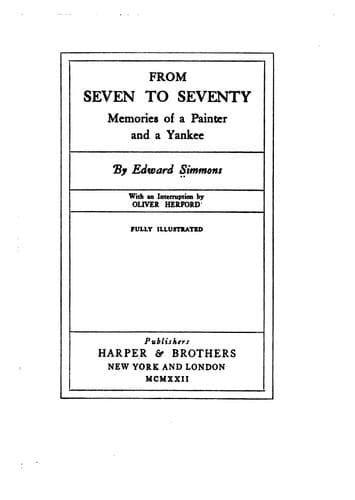
From Seven to Seventy: Memories of a Painter and a Yankee — John Shaqi
From Seven to Seventy: Memories of a Painter and a YankeeSimmons, Edward
General
From Seven to Seventy: Memories of a Painter and a Yankee
Simmons, Edward
Artists -- Biography
I have my small triumphs. One occurred in the Hasty Pudding Club. When I
went back for a visit after coming home from Europe, I was shown a fine
building, positively shaming the rooms we had had in Stoughton Hall. I
went in with a somewhat bewildered manner, feeling like a stranger in a
strange land. Then something struck my eye. Where had I seen it before?
There at the end of a hall was a drawing—a playbill for a performance of
“The Rivals”—of two cocks, one black and the other of the yellow
barnyard type, fighting over a little white hen. Looking in the corner,
I saw it was signed with my name!
It is better than money, family, or friends when a whole generation
embraces you. My personality was not there; neither is that of the man
who made the Venus di Milo—but _she’s_ there. There are contests as to
who wrote the plays we ascribe to Shakespeare, but there are no contests
over Hamlet. It’s great to see that what you have tried to do has been
kept.
There is a poem by Arthur Macy (probably not published) about a Common
Councilman who in walking down the street and, happening to look up at
the Boston Public building, sees a shield and upon it the design by
Saint-Gaudens, of two little naked boys. It runs something like this:
What nameless horror meets his modest eyes?
· · · · ·
There, reared aloft in perfect equipoise,
Two very small, unexpurgated boys.
Hurrying down to the meeting hall, he has the Council pass a bill that
after this “boys shall be born in pants.” The only difference in the
opinion of my rival fraternity at college—namely, the Alpha Delta
Phis—would have been that they should be born clothed; but after talking
it over, they would have decided it should be in “trousers.” This
substitution of a good old Anglo-Saxon word for one of Latin slang would
have been due to the influence of our beloved Professor Child, whom we
all called “Stubby.”
“Stubby” Child represented a natural revolt against Bostonianism—the
practice of putting pantalettes on piano legs. To him his language was a
faith or a religion, and I know that all America would speak and write
much worse English to-day were it not for the disciples that this man
scattered throughout the country. The secret of his influence was that
he _cared_, and therefore he produced a result. He was unimportant to
look at, had no voice to speak of, and exercised no hypnotism, but he
managed to imbue us all with a permanent love of our own language. I am
sure he would as soon have thought of using a foreign word in place of
an Anglo-Saxon word or its derivative, as he would of dishonoring his
own mother. His influence was more powerful, because it was subtle, and
although he does not seem to be well known, I have met men in many parts
of the world who immediately fell on my neck when I said I had been the
the pupil of “Stubby” Child.
Public-domain text, read in full here on John Shaqi.
Reviews
Reviews
No reviews yet
Be the first to share your thoughts on this work.
Join the Discussion
Join the discussion
Sign in to leave a comment or review.
Sign InorCreate an account