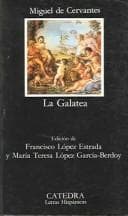
Spanish fiction -- Translations into English; Spanish poetry -- Translations into English
It would be idle to deny that the _Galatea_ has many defects of
the school to which it belongs, but it must always have a singular
interest as being the first serious literary experiment made by a
writer of consummate genius. Cervantes had the model, the sacred model,
perpetually before his eyes, and he copied it (if not with conviction)
with a grim determination which speaks for itself. He, too,--the
_ingenio lego_--must be interpolating his learning, and referring to
Virgil, Ovid, Propertius and the rest of them, with an air of intimate
familiarity. Twenty years afterwards, when he had outgrown these little
affectations, and was penning the amusing passage in which he banters
Lope's childish pedantry,[59] the brilliant humorist must surely have
smiled as he remembered his own performances in the same kind. He
does honour to the grand tradition of prolixity by putting wiredrawn
conceits into the mouths of shepherds who are much more like love-sick
Abelards than like Comatas or Lacon, and, when his own stock of
scholastic subtleties is ended, he has no scruple in allotting to Lenio
and Tirsi[60] a short summary of the arguments which had been used
long before by Filone and Sofía in his favourite book, León Hebreo's
_Dialoghi di Amore_.[61] Had he taken far more material than he
actually took, he would have been well within his rights, according to
the prevailing ideas of literary morality. Whatever illiterate admirers
may say, it is certain that Cervantes followed the fashion in borrowing
freely from his predecessors. No careful reader of the _Galatea_ can
doubt that its author either had Sannazaro's _Arcadia_ on his table, or
that he knew it almost by heart.[62] His appreciation for the _Arcadia_
was unbounded, and in the _Viaje del Parnaso_[63] the sight of Posilipo
causes him to link together the names of Virgil and Sannazaro:--
Vímonos en un punto en el paraje,
Do la nutriz de Eneas piadoso
Hizo el forzoso y último pasaje.
Vimos desde allí á poco el más famoso
Monte que encierra en sí nuestro hemisfero,
Más gallardo á la vista y más hermoso.
Las cenizas de Títiro y Sincero
Están en él, y puede ser por esto
Nombrado entre los montes por primero.
In the _Galatea_, enthusiasm takes the form of conscientious imitation.
It cannot be mere coincidence that Ergasto's song--_Alma beata et
bella_--is echoed by Elicio as _O alma venturosa_; that such a
_ritornello_ as _Ricominciate, o Muse, il vostro pianto_ reappears
as _Pastores, entonad el triste canto_; that _Ponete fin, o Muse,
al vostro pianto_ is rendered as _Pastores, cesad ya del triste
canto_. The sixth book of the _Galatea_ is an undisguised adaptation
of Sannazaro's work. In view of these resemblances, and many others
indicated by Professor Scherillo,[64] the large indebtedness of
Cervantes to Sannazaro cannot be denied.
Public-domain text, read in full here on John Shaqi.
Reviews
Reviews
No reviews yet
Be the first to share your thoughts on this work.
Join the Discussion
Join the discussion
Sign in to leave a comment or review.
Sign InorCreate an account