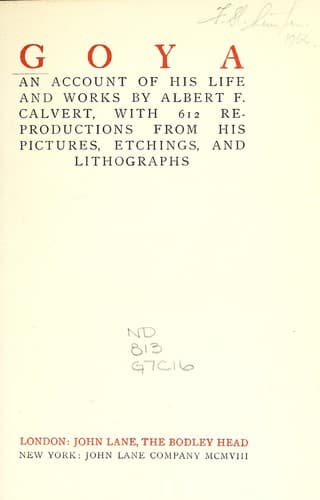
Goya, an account of his life and works — John Shaqi
Goya, an account of his life and worksCalvert, Albert Frederick
History
Goya, an account of his life and works
Calvert, Albert Frederick
Goya, Francisco, 1746-1828
The hopes of the Spanish nation were centred in the Crown Prince
Ferdinand. Even as the First of the Tigers thought to exterminate Fear
by killing a man, the Spaniards believed that the abdication of Charles
IV. would make an end of misrule and give their country peace and
prosperity. But the King hated his son, and inspired by the double
purpose of defeating the ambition of the Crown Prince and punishing the
disloyalty of his subjects, he laid his crown at the feet of the Emperor
of the French, who bestowed it upon his brother, Joseph Buonaparte. The
Spanish liberals made the alien king welcome, but the Spanish loyalists
proved a constant thorn in the side of the usurper, and at the end of
five years Joseph Buonaparte fled Madrid. Two years later the Prince of
the Asturias returned to Spain to be crowned king as Ferdinand VII.
Again the distressful country was plunged into the depths of
retrogression, clericalism, and fanaticism. Spain was undergoing her
fate.
The strong men of the troublous times of the eighteenth century were the
revolutionaries and reformers, and, as was inevitable, they sprang from
the people. Rousseau, Robespierre, Napoleon, these were the forces that
directed the movement, the effect of which was to make itself felt from
one end of Europe to the other. Goya was a revolutionary. He lived under
four kings of Spain. He was elected a member of the Académia de San
Fernando in the reign of Charles III.; Charles IV. appointed him _Pintor
de Cámara del Rey_; he took the oath of allegiance to Joseph Buonaparte
and painted the usurper’s portrait; Ferdinand VII., who declared that he
had deserved death for his defection from the Bourbon cause, condemned
the man but pardoned the artist and received him as a member of the new
Court. Critical opinion condones Goya’s flexible patriotism by the fact
that ‘it was a period of national disaster,’ and that ‘national calamity
was not altered by these trivialities.’
Public-domain text, read in full here on John Shaqi.
Reviews
Reviews
No reviews yet
Be the first to share your thoughts on this work.
Join the Discussion
Join the discussion
Sign in to leave a comment or review.
Sign InorCreate an account