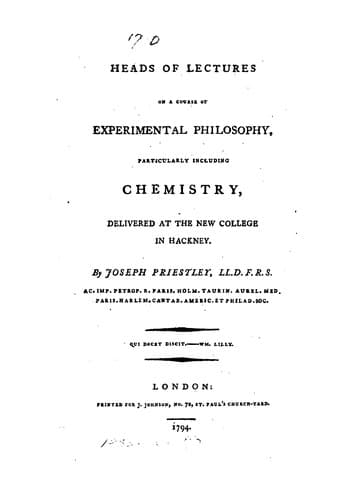
Heads of Lectures on a Course of Experimental Philosophy: Particularly Including ChemistryPriestley, Joseph
Philosophy
Heads of Lectures on a Course of Experimental Philosophy: Particularly Including Chemistry
Priestley, Joseph
Chemistry -- Early works to 1800
When two substances compose one liquid, and a third, which has a
stronger affinity with either of the two parts than they have with each
other, is added to them, it will unite with that part, and take its
place in the solution, while the other will in many cases be
precipitated, and may be collected. Thus the earth of alum is
precipitated from a solution of alum by salt of tartar. This is the case
of _simple affinity_.
When both the substances are compounds, the component parts of which
have a weaker affinity with each other than they have with those of the
other compound, two new combinations are formed, and this is called a
case of _double affinity_. Thus when phlogisticated alkali is poured
into a solution of green vitriol, the acid of the vitriol unites with
the alkali, while the phlogiston joining the calx of iron makes Prussian
blue.
All nature lying open to our investigation, we must consider the
different parts in some order. But it is not very material which we
adopt, because, begin where we will, the properties of the substances we
first treat of will be connected with those which must be particularly
considered afterwards, the changes in one substance being occasioned by
its union with another. It will be impossible, for example, to explain
the properties of metals without considering the _acids_, because by
their union with acids very important changes are made in their
properties.
There have been three principal methods of arranging natural substances.
One is according to the _three kingdoms_, as they are called, into which
they have been distributed, viz. the _mineral_, the _vegetable_, and the
_animal_. Another is according to the _elements_ which enter into their
composition, and a third according to the _form_ in which they are
usually found, viz. _aerial_, _fluid_, or _solid_. Upon the whole this
last appears to me to be the most convenient, especially as it is easy
to intermix general observations concerning the other divisions when
they are particularly wanted. As there will be frequent occasion to
speak of the component and elementary parts of all substances, I shall
here observe, that, according to the latest observations, the following
appear to be the elements which compose all natural substances, viz.
_dephlogisticated air_, or the _acidifying principle_; _phlogiston_, or
the _alkaline principle_; the different _earths_, and the principles of
_heat_, _light_, and _electricity_. Besides these, there are the
following principles which have not been proved to be substances, viz.
_attraction_, _repulsion_, and _magnetism_. By the help of these
principles we are able, according to the present state of natural
knowledge, to explain all the appearances that have yet occurred to us.
LECTURE II.
_Of the Properties of all Matter._
Public-domain text, read in full here on John Shaqi.
Reviews
Reviews
No reviews yet
Be the first to share your thoughts on this work.
Join the Discussion
Join the discussion
Sign in to leave a comment or review.
Sign InorCreate an account