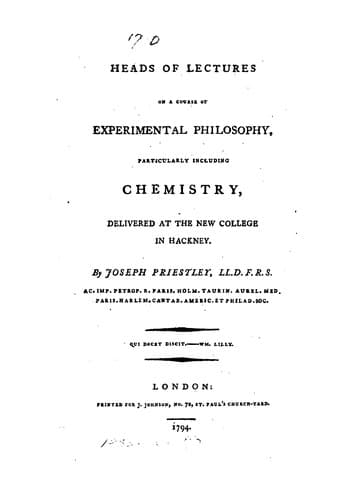
Heads of Lectures on a Course of Experimental Philosophy: Particularly Including Chemistry — John Shaqi
Heads of Lectures on a Course of Experimental Philosophy: Particularly Including ChemistryPriestley, Joseph
Philosophy
Heads of Lectures on a Course of Experimental Philosophy: Particularly Including Chemistry
Priestley, Joseph
Chemistry -- Early works to 1800
Water has an affinity to, and combines with, almost all natural
substances, aerial, fluid, or solid; but most intimately with acids,
alkalies, calcareous earth, and that calx of iron which is called
_finery cinder_, from which the strongest heat will not expel it.
It has been supposed by some, that by frequent distillation, and also by
agitation, water may be converted into a kind of earth; but this does
not appear to be the case. It has also of late been thought, that water
is resolvable into dephlogisticated and inflammable air; but the
experiments which have been alleged to prove this do not satisfy me; so
that, for any thing that appeared till very lately, water might be
considered as a simple element. By means of heat, however, it seems to
be resolvable into such air as that of which the atmosphere consists,
viz. dephlogisticated and phlogisticated, only with a greater proportion
of the former.
Water, with respect to specific gravity and temperature, has generally
been made the standard to all other substances; its freezing and boiling
points being the limits by means of which thermometers are graduated.
Other substances have also been compared with water, as a standard,
with respect to the capacity of receiving heat, and retaining it in a
latent state, as will be shewn when we consider the subject of heat.
LECTURE XII.
_Of the Nitrous Acid._
Under the head of _liquids_ I shall consider _acids_ and _alkalis_,
though some of them may be exhibited in the form of air, and others in a
solid form. These two chemical principles are formed to unite with one
another, and then they constitute what is called a _neutral salt_.
Both acids and alkalis are distinguishable by their taste. Another test,
and more accurate, is, that acids change the blue juices of vegetables
red, and alkalis turn the syrup of violets green.
Acids are generally distinguished according to the three kingdoms to
which they belong, viz. _mineral_, _vegetable_, and _animal_. The
mineral acids are three, the _nitrous_, the _vitriolic_, and the
_marine_.
The nitrous acid is formed by the union of the purest inflammable air,
or the purest nitrous air, with dephlogisticated air. But it is usually
procured from nitre by means of the vitriolic acid, which, seizing its
base, expels the nitrous acid in a liquid form. On this account this
acid is said to be weaker than the vitriolic.
If the nitrous acid be made to pass through a red-hot earthen tube, it
will be decomposed, and the greatest part of it be converted into
dephlogisticated air.
Public-domain text, read in full here on John Shaqi.
Reviews
Reviews
No reviews yet
Be the first to share your thoughts on this work.
Join the Discussion
Join the discussion
Sign in to leave a comment or review.
Sign InorCreate an account