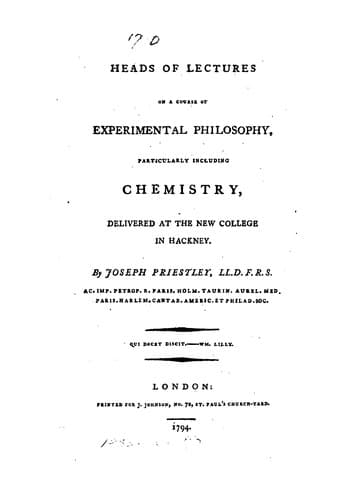
Heads of Lectures on a Course of Experimental Philosophy: Particularly Including ChemistryPriestley, Joseph
Philosophy
Heads of Lectures on a Course of Experimental Philosophy: Particularly Including Chemistry
Priestley, Joseph
Chemistry -- Early works to 1800
Like all other acids, the nitrous acid has a strong affinity to water;
but it is not capable of so much concentration as the vitriolic. It is
generally of an orange or yellow colour; but heat will expel this colour
in the form of a red vapour, which is the same acid in the form of air,
and loaded with phlogiston; and therefore when it is colourless it is
said to be dephlogisticated. But the colourless vapour exposed to heat,
or to light, will become coloured again; and the liquid acid imbibing
this coloured vapour, becomes coloured as before. This acid tinges the
skin of a yellow colour, which does not disappear till the epidermis be
changed.
The nitrous acid unites with phlogiston, alkalis, metallic substances,
and calcareous earth.
By means of its affinity with phlogiston it occasions that rapid
accension called _detonation_, when any salt containing this acid,
especially nitre, is applied to hot charcoal, or when charcoal is put to
hot nitre. In fact, the charcoal burns so rapidly by means of the
dephlogisticated air supplied by the nitre.
A mixture of sulphur assists the accension of these substances, and
makes gunpowder, in the explosion of which much nitrous or
phlogisticated air is suddenly produced, and expanded by the heat. The
application of this force, both to useful and destructive purposes, is
well known. If, instead of nitre, a salt made with dephlogisticated
marine acid be made use of, the explosion is more easily produced, and
is much more violent. Friction will do this as well as heat.
Nitre also enters into the composition of _pulvis fulminans_, viz. three
parts nitre, two of dry alkali, and one of sulphur. This composition
melts, and yields a blue flame, before it explodes.
By means of the affinity of the nitrous acid to _oil_, another substance
containing phlogiston, it is capable of producing not only a great heat,
but even a sudden flame, especially when mixed with a little vitriolic
acid.
Nitrous acid dissolves all metallic substances except gold and platina,
and in the solution nitrous air is produced.
The particular kinds of saline substances formed by the union of the
nitrous acid with the several metals and earths may be seen in tables
constructed for the purpose. They are all deliquescent.
LECTURE XIII.
_Of the Vitriolic Acid._
The vitriolic acid, so called because it was originally procured from
_vitriol_, is now generally procured from sulphur; the dephlogisticated
part of the air uniting with it in the act of burning.
That dephlogisticated air is essential to this acid is evident from the
decomposition of it; for if the vapour of it be made to pass through a
red-hot earthen tube, a great quantity of dephlogisticated air is
procured.
Public-domain text, read in full here on John Shaqi.
Reviews
Reviews
No reviews yet
Be the first to share your thoughts on this work.
Join the Discussion
Join the discussion
Sign in to leave a comment or review.
Sign InorCreate an account