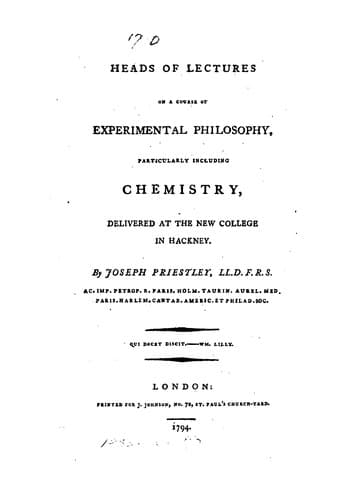
Heads of Lectures on a Course of Experimental Philosophy: Particularly Including ChemistryPriestley, Joseph
Philosophy
Heads of Lectures on a Course of Experimental Philosophy: Particularly Including Chemistry
Priestley, Joseph
Chemistry -- Early works to 1800
This acid has a strong affinity to water, with which it unites with much
heat; and it is capable of greater concentration, or of being made
specifically heavier, than any other acid. When pure, it is entirely
free from colour and smell, owing, probably, to its being free from
phlogiston, which is inseparable from the nitrous or marine acids.
The vitriolic acid will dislodge the nitrous, or marine, or any other
acid, from their earthy or metallic bases; from which property it is
called the strongest of all the acids.
By means of the superior affinity of the vitriolic acid to earths, and
especially to _terra ponderosa_, the smallest quantity of it in water
may be discovered by a solution of this earth in the marine acid. In
this acid the terra ponderosa is held in perfect solution; but with the
vitriolic acid it forms a substance that is insoluble in water, and
therefore it instantly appears in the form of a white cloud.
Perhaps chiefly from the strong affinity which this acid has with water,
_pyrophorus_, consisting of a mixture of alum and several substances
containing phlogiston, takes fire spontaneously on exposure to the air.
It is commonly made of three parts of alum and one of brown sugar, or of
two parts alum, one of salt of tartar, and one of charcoal. They must be
heated till they have for some time emitted a vapour that burns with a
blue flame.
The saline substances produced by the union of this acid with the
several earths and metals, are best exhibited in tables constructed for
the purpose. When united to three of the metals, viz. iron, copper, and
zinc, they are called _vitriols_, green, blue, and white. And all the
substances which this acid unites with crystallize, and do not
deliquesce.
This acid unites with oil, and the mixture is always black.
When any substance containing phlogiston is heated in the vitriolic
acid, another species of the acid, called _sulphureous_, is formed, of a
pungent smell. In reality, it is water impregnated with vitriolic acid
air. It makes, however, a distinct species of acid, and is dislodged
from its base by most of the others.
_Of the Marine Acid._
The marine acid is procured from common salt by the vitriolic acid,
which unites with its base, the fossil alkali.
This acid is generally of a straw-colour; but this is owing to an
impregnation with some earthy matter, most of which it readily
dissolves, especially the metallic ones. It is less capable of
concentration than the vitriolic or nitrous acids, perhaps from a more
intimate union of phlogiston with it. No heat can extract from it any
dephlogisticated air.
Public-domain text, read in full here on John Shaqi.
Reviews
Reviews
No reviews yet
Be the first to share your thoughts on this work.
Join the Discussion
Join the discussion
Sign in to leave a comment or review.
Sign InorCreate an account