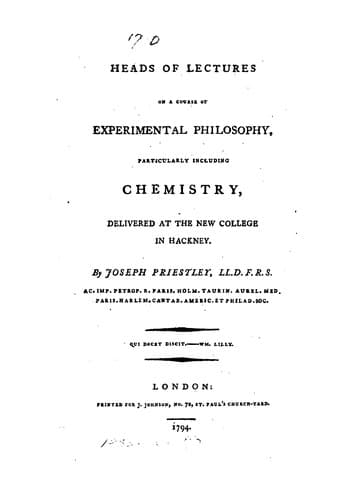
Heads of Lectures on a Course of Experimental Philosophy: Particularly Including Chemistry — John Shaqi
Heads of Lectures on a Course of Experimental Philosophy: Particularly Including ChemistryPriestley, Joseph
Philosophy
Heads of Lectures on a Course of Experimental Philosophy: Particularly Including Chemistry
Priestley, Joseph
Chemistry -- Early works to 1800
Spirit of wine will not dissolve the gummy parts of vegetables; and by
this means the gummy substances may be separated from their solutions in
water, the spirit uniting with the water only. On the other hand, if
resins be dissolved in spirit of wine, the affusion of water will
separate them. By means of the affinity of spirit of wine with water, it
will seize upon the water in which several salts are dissolved, and thus
produce an instant crystallization of them.
Salt of tartar has a greater affinity to water than spirit of wine, and
by extracting water from it, will assist in concentrating it; but the
best method of rendering spirit wine free from water is distillation,
the ardent spirit rising before the water.
Spirit of wine mixed with the vitriolic and other mineral acids, renders
them milder, and thereby more proper for certain medicinal uses. This is
called _dulcifying_ them.
Spirit of wine is a powerful antiseptic, and is therefore of use to
preserve vegetable and animal substances from putrefaction.
_Of AEther._
If spirit of wine be distilled with almost any of the acids, the produce
is a liquor which has obtained the name of _AEther_, from its extreme
lightness and volatility, being much lighter, and more volatile, than
any other fluid that we are acquainted with. It is highly inflammable,
but the burning of it is accompanied with smoke, and some soot; and on
this account it is a medium between spirit of wine and oil, the acid
having taken from the spirit of wine part of the water that was
essential to it, at the same time that it communicated something of its
acid peculiarly modified; since aethers have different properties
according to the acids by which they are made; as the _vitriolic_, the
_nitrous_, the _marine_, and the _acetous_. No aether, however, can be
made from the marine acid till it has been in some measure
dephlogisticated; from which it may be inferred, that dephlogisticated
air is necessary to the composition of aether. Vitriolic aether is the
most common, in consequence of the process by which it is made being the
easiest.
AEther does not mix with water in all proportions, like spirit of wine,
but ten parts of water will take up one of aether. It easily mixes with
all oils.
It is something remarkable, that though aether will not dissolve gold, it
will take from aqua regia the gold that has been previously dissolved in
it.
By the quick evaporation of aether a considerable degree of cold may be
procured; and on this principle it has sometimes been applied to relieve
the head-ach and other pains.
LECTURE XVIII.
_Of Oil._
Oil is a liquid inflammable substance, of great tenacity, disposed to
pour in a stream rather than in drops. It is little, if at all, soluble
in water. It burns with smoke and soot, and leaves a residuum of a coaly
substance. It consists of acid and water combined with phlogiston.
Public-domain text, read in full here on John Shaqi.
Reviews
Reviews
No reviews yet
Be the first to share your thoughts on this work.
Join the Discussion
Join the discussion
Sign in to leave a comment or review.
Sign InorCreate an account