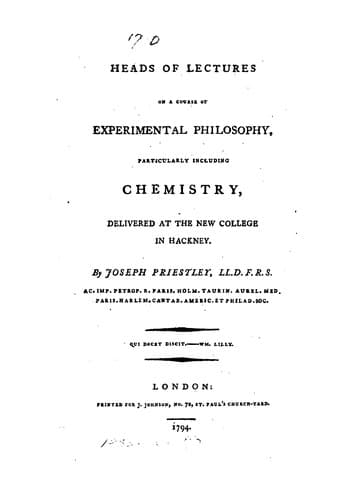
Heads of Lectures on a Course of Experimental Philosophy: Particularly Including Chemistry — John Shaqi
Heads of Lectures on a Course of Experimental Philosophy: Particularly Including ChemistryPriestley, Joseph
Philosophy
Heads of Lectures on a Course of Experimental Philosophy: Particularly Including Chemistry
Priestley, Joseph
Chemistry -- Early works to 1800
All oil is the produce of the vegetable or animal kingdom, no proper
mineral substance containing any of it.
By distillation oil is in part decomposed, and by this means the thicker
kinds of oil are rendered thinner and more volatile, the acid, to which
their consistence is chiefly owing, being lost in the process. By
repeated distillation it is supposed that all oils may be brought almost
to the state of aether, and even of ardent spirit.
Acids act powerfully upon oils, but very differently, according to the
nature of each. Alkalies also combine with oils, and the less thin and
volatile they are, the more easily are they soluble in alkalies. The
union of alkali and oil makes _soap_. All oil dissolves sulphur, and
with it makes what is called a _balsam_. Oils also dissolve metallic
substances, but most sensibly copper and lead. United with the calx of
lead, it is used in painting.
Oil not readily mixing with water, it will diffuse itself over its
surface, and, notwithstanding its tenacity, it will do this very
rapidly, and to a great extent; and then it has the extraordinary
effect of preventing the action of the wind upon the water, so as to
prevent the forming of waves. If a quantity of oil and water be put into
a glass vessel and swung, the surface of the water below the oil will be
seen to change with respect to the vessel, but not that of the oil. If
spirit of wine be put upon them, that will be at rest, and both the
lower fluids in motion.
Vegetable oil is of two kinds, the _soft_, or _mild_, which has little
or no taste or smell, and the _essential_ oil, which is thin, and
retains the smell and taste of the plant from which it was extracted.
Mild or sweet oil is expressed from the grains or kernels of vegetables,
and requires a considerable degree of heat to convert it into vapour, in
which state alone it is capable of being inflamed.
_Essential oil_ is volatile in the heat of boiling water, and is
generally obtained by means of distillation from the most odoriferous
sorts of plants; but is sometimes found in their vesicles, as in the
rind of an orange. The strong taste of this kind of oil arises from the
disengaged acid which abounds in it; and by this means it is soluble in
spirit of wine, which sweet oil is not; but it loses much of this
property by repeated distillations. By long exposure to the air it loses
its more volatile parts, and thereby approaches to the nature of a
resin. This volatile odoriferous principle has been called the _spiritus
rector_ of the plant.
Public-domain text, read in full here on John Shaqi.
Reviews
Reviews
No reviews yet
Be the first to share your thoughts on this work.
Join the Discussion
Join the discussion
Sign in to leave a comment or review.
Sign InorCreate an account