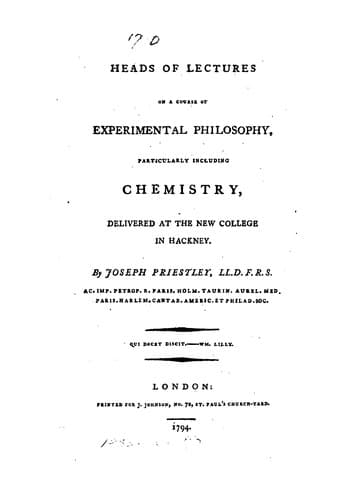
Heads of Lectures on a Course of Experimental Philosophy: Particularly Including ChemistryPriestley, Joseph
Philosophy
Heads of Lectures on a Course of Experimental Philosophy: Particularly Including Chemistry
Priestley, Joseph
Chemistry -- Early works to 1800
The essential oils of different plants differ much in their specific
gravity, and also in the manner by which they are affected by cold, some
being heavier and others lighter than water, and some being more
difficultly, and others more easily, congealed. Though the differences
with respect to _weight_ and _consistency_ in these oils is probably
owing to the state of the acid that is combined with them, these two
properties are wholly independent of each other; some essential oils
being very thin and yet heavy, and others thick and yet light. Essential
oils are used in perfumes, and also in medicine, acting powerfully the
nervous system.
Essential oils are very apt to be adulterated. If it be with sweet oil,
it may be discovered by evaporation on white paper, or by a solution in
spirit of wine, which will not act upon the sweet oil. If spirit of wine
be mixed with it, it will be discovered by a milky appearance upon
putting water to it, which uniting with the spirit, will leave the oil
much divided. If oil of turpentine, which is the cheapest of essential
oils, be mixed with any of the more valuable kinds, it will be
discovered by evaporation; a strong smell of turpentine being left on
the paper, or cloth, upon which the evaporation was made.
Animal oil, like the vegetable, is of two kinds; the first _butter_, or
_fat_, which is easily congealed, owing to the quantity of acid that is
intimately combined with it. It resembles the sweet oil of vegetables in
having no smell or taste. The other kind of animal oil is extracted by
distillation from the flesh, the tendons, the bones, and horns, &c. of
animals. It differs essentially from the other kind of animal oil, by
containing an alkali instead of an acid. By repeated distillation it
becomes highly attenuated and volatile; and in this state it is called
the _oil of Dippel_, the discoverer of it.
All oil exposed to much heat is in part decomposed, and acquires a
disagreeable smell; and in this state it is said to be _empyreumatic_:
but this property is lost by repeated distillations.
Besides the vegetable and animal oils above described, there is a fossil
oil called _bitumen_, the several kinds of which differ much in colour
and consistence; the most liquid is called _petroleum_, from being found
in the cavities of rocks, and the more solid kinds are _amber_, _jet_,
_asphaltum_, and _pit-coal_. When distilled, the principal component
parts of all these substances are an oil and an acid. But all fossil oil
is probably of vegetable or animal origin, from masses of vegetables or
animals long buried in the earth. Their differences from resins and
other oily matters are probably owing to _time_; the combinations of
mineral acids and oils so nearly resembling bitumens, the principal
difference being their insolubility in spirit of wine.
Public-domain text, read in full here on John Shaqi.
Reviews
Reviews
No reviews yet
Be the first to share your thoughts on this work.
Join the Discussion
Join the discussion
Sign in to leave a comment or review.
Sign InorCreate an account