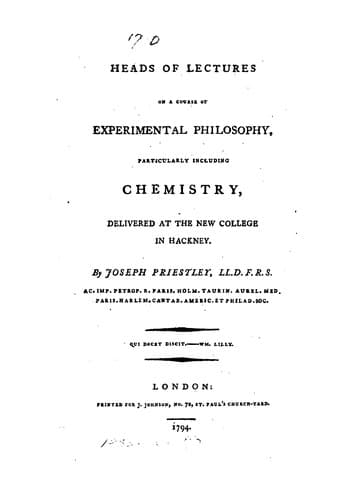
Heads of Lectures on a Course of Experimental Philosophy: Particularly Including ChemistryPriestley, Joseph
Philosophy
Heads of Lectures on a Course of Experimental Philosophy: Particularly Including Chemistry
Priestley, Joseph
Chemistry -- Early works to 1800
That the most solid of these, as amber, has been formerly in a liquid
state, is evident, from insects and other substances being frequently
found in them; and pit-coal has been often found with both the internal
texture and external appearance of wood; so that strata of pit-coal have
probably been beds of peat in some former state of the earth.
LECTURE XIX.
_Of Solid Substances._
All solid substances are capable of becoming fluid by heat, and most of
them may thereby be reduced into a state of vapour, or air; and in
passing from a fluid into a solid state their component parts assume a
particular mode of arrangement, called _crystallization_, which differs
according to the nature of the substance; so that all solids, especially
if they be suffered to concrete slowly, may be called _crystals_.
Exclusive of _salts_, which have been considered already, as formed by
the union of acids and alkalis, solids in general have obtained the
names of _earths_, or _stones_, which differ only in their texture; and
they are distinguished into those that are _metallizable_, or those that
are not; the former being called _ores_, and the latter simply _earths_;
the principal of which are the _calcareous_, _siliceous_,
_argillaceous_, _magnesia_, _terra ponderosa_, and a few others which
have been discovered lately, but have not been much examined.
_Of Calcareous Earth._
Calcareous earth is found in the shells of fishes, the bones of animals,
chalk, lime-stone, marble, and gypsum: but all calcareous earth is
supposed to be of animal origin; and beds of chalk, lime-stone, or
marble, are thought to have been beds of shells formed in the sea, in
some pristine state of the earth.
The calcareous earth which is found in shells, lime-stone, and marble,
is combined with fixed air, discovered by effervescing with acids. To
obtain it perfectly pure, the earth must be pounded and washed with
water, in order to free it from any saline substance which may be
contained in it, then dissolved in distilled vinegar, and precipitated
by mild alkalies. Lime-stone exposed to heat loses about half its
weight, in fixed air and water, and the remainder, called _quick-lime_,
attracts water very powerfully, and their union is attended with much
heat, after which it dissolves into a fine powder called _slaked lime_.
If it be left exposed to the atmosphere, it will of itself, by gradually
imbibing moisture, fall into the state of powder.
Water dissolves about one seven hundredth part of its weight of
quick-lime, and is then called _lime-water_. Exposed to the air, a crust
will be formed on its surface, which is found to consist of calcareous
earth and fixed air.
Lime and water mixed with sand make _mortar_, by which means different
stones may be made to cohere as one mass, which is the most valuable
use of this kind of earth.
Public-domain text, read in full here on John Shaqi.
Reviews
Reviews
No reviews yet
Be the first to share your thoughts on this work.
Join the Discussion
Join the discussion
Sign in to leave a comment or review.
Sign InorCreate an account