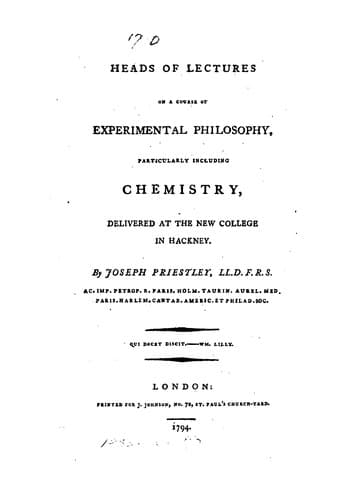
Heads of Lectures on a Course of Experimental Philosophy: Particularly Including ChemistryPriestley, Joseph
Philosophy
Heads of Lectures on a Course of Experimental Philosophy: Particularly Including Chemistry
Priestley, Joseph
Chemistry -- Early works to 1800
Calcareous earth, united with vitriolic acid, makes _gypsum_; and this
substance pounded and exposed to heat, parts with its water, and is then
called _plaister of Paris_. In this state, by imbibing water again, it
becomes a firm substance, and thus is useful in making moulds, &c.
The earth of animal bones is calcareous united to the phosphoric acid.
_Of Siliceous Earth._
Siliceous earth seems to be formed by nature from chalk, perhaps by the
introduction of some unknown acid, which the vitriolic acid is not able
to dislodge. It abounds in most substances which are hard enough to
strike fire with steel, as _flint_, _rock crystal_, and most _precious
stones_. It is not acted upon by any acid except the fluor and
phosphoric, but especially the former: but it is soluble in alkalies;
and being then dissolved in water, makes _liquor silicum_, from which
the purest siliceous earth may be precipitated by acids. For this
purpose about four times the weight of alkali must be made use of. With
about equal weights of alkali and siliceous sand is made _glass_, of so
great use in admitting light and excluding the weather from our houses,
as well as for making various useful utensils. To make glass perfectly
colourless, and at the same time more dense, commonly called _flint
glass_, manufacturers use a certain proportion of calx of lead and
manganese.
Siliceous earth is not affected by the strongest heat, except by means
of a burning lens, or dephlogisticated air.
LECTURE XX.
_Of Argillaceous Earth._
Argillaceous earth is found in _clay_, _schistus_, or _slate_, and in
_mica_; but the purest is that which is precipitated from a solution of
alum by alkalies; for alum consists of the union of vitriolic acid and
argillaceous earth.
This species of earth is ductile with water; it then hardens and
contracts by heat, so as to be of the greatest use in forming _bricks_,
or stones of any required form or size. By means of the property of clay
to contract in the fire, Mr. Wedgwood has constructed an excellent
thermometer to measure the degrees of extreme heat.
The ductility of clay seems to depend upon some acid, probably the
vitriolic, adhering to it; for it loses that property when it is burned
into a brick, but recovers it when it has been again dissolved in an
acid.
_Of Terra Ponderosa._
_Terra ponderosa_, or _marmor metallicum_, is generally found in two
states, viz. united to vitriolic acid, when it is called _calk_, or to
fixed air, when it is called _terra ponderosa aerata_.
Public-domain text, read in full here on John Shaqi.
Reviews
Reviews
No reviews yet
Be the first to share your thoughts on this work.
Join the Discussion
Join the discussion
Sign in to leave a comment or review.
Sign InorCreate an account