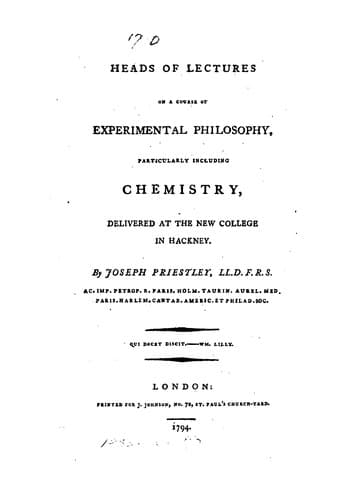
Heads of Lectures on a Course of Experimental Philosophy: Particularly Including ChemistryPriestley, Joseph
Philosophy
Heads of Lectures on a Course of Experimental Philosophy: Particularly Including Chemistry
Priestley, Joseph
Chemistry -- Early works to 1800
To obtain it pure from its union with the vitriolic acid, it must be
melted with about twice its weight of fixed alkali; which unites with
the acid, and forming a saline substance, may be washed out of it. In
this state it contains water, and therefore, when exposed to heat, will
yield fixed air; whereas the terra ponderosa aerata will not yield fixed
air by heat only, but when steam is made to pass over it when red hot.
This proves that water is essential to the composition of fixed air.
This stone is distinguishable by its great specific gravity, being four
times as heavy as water; but though in this it resembles an _ore_, it
has not been found to be metallizable.
_Of Magnesia._
This species of earth is found in _steatites_, or _soap rock_, _Spanish
chalk_, _asbestus_, and _Muscovy talck_; but the purest is got by
dissolving _Epsom salts_ (which consists of this earth united to the
vitriolic acid) and precipitating it by a mild alkali. In this state it
becomes united to fixed air, which may be expelled by heat. It is then
_calcined_, or _caustic_, but differs from quick-lime by not being
soluble in water.
_Asbestus_, which contains much of this kind of earth, is remarkable for
not being destructible by heat, though it is sometimes found in flexible
fibres, so as to be capable of being woven into cloth.
_Muscovy talck_ is remarkable for the thin and transparent flakes into
which it is divisible, and thereby capable of various uses.
There are some other distinct species of earth, particularly one brought
from Botany Bay, and another called _Stontiate_, from the place where it
was found in Scotland; but they have not as yet been much examined.
All stones formed by nature are compounded, and to distinguish them from
one another, and ascertain the parts of which they consist, is the
subject of _lithology_, a very extensive branch of knowledge.
All the simple earths are nearly, if not absolutely, _infusible_; but
when they are mixed they may all be fused.
LECTURE XXI.
_Of Ores_.
Metallizable earths, commonly called _ores_, when united to phlogiston,
make the metals, distinguishable for their specific gravity, their
opacity, shining appearance, and fusibility.
All the proper metals are _malleable_, and those which are not so are
called _semi-metals_.
The metals again are subdivided into the _perfect_ and _imperfect_. The
former, which are _gold_, _silver_, and _platina_, suffer no change by
fusion, or the longest continued heat: whereas heat calcines or
dissipates the phlogiston of the imperfect metals, which are _mercury_,
_lead_, _copper_, _iron_, and _tin_, so that they return to the state of
earth; and this earth is always heavier than the metal, though of less
specific gravity, having received an addition of weight from water or
air: but these earths, or ores, being exposed to heat in contact with
substances containing phlogiston, again become metals, and are then said
to be _revived_.
Public-domain text, read in full here on John Shaqi.
Reviews
Reviews
No reviews yet
Be the first to share your thoughts on this work.
Join the Discussion
Join the discussion
Sign in to leave a comment or review.
Sign InorCreate an account