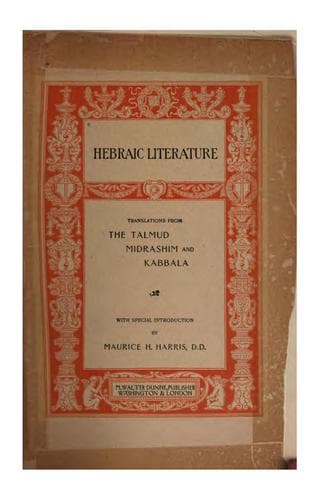
Hebraic Literature; Translations from the Talmud, Midrashim and Kabbala
Religion
Hebraic Literature; Translations from the Talmud, Midrashim and Kabbala
Hebrew literature -- Translations into English
The question asked above by Acheer has been practically resolved
by all wise men from the beginning of the world, but it is the
boast of the Hegelians that it has for the first time been
resolved philosophically by their master. Others had maintained
that you could not think a thing but through its opposite; he
first maintained it could not exist but through its opposite,
that, in fact, the thing and its opposite must needs arise
together, and that eternally, as complements of one unity: the
white is not there without the black, nor the black without the
white; the good is not there without the evil, nor the evil
without the good.
Pride is unbecoming in women. There were two proud women, and their
names were contemptible; the name of the one, Deborah, meaning wasp, and
of the other, Huldah, weasel. Respecting the wasp it is written (Judges
iv. 6), "And she sent and called Barak," whereas she ought to have gone
to him. Concerning the weasel it is written (2 Kings xxii. 15), "Tell
the man that sent you," whereas she should have said, "Tell the king."
_Meggillah_, fol. 14, col. 2.
If speech is worth one sela (a small coin so called), silence is worth
two.
Ibid., fol. 18, col. 1.
The Swiss motto, "Speech is worth silver, silence worth gold,"
expresses a sentiment which finds great favor with the authors
and varied expression in the pages of the Talmud.
If silence be good for wise men, how much better must it be for fools!
_P'sachim_, fol. 98, col. 2.
For every evil silence is the best remedy.
_Meggillah_, fol. 18, col. 1.
Silence is as good as confession.
_Yevamoth_, fol. 87, col. 1.
Silence in a Babylonian was a mark of his being of good family.
_Kiddushin_, fol. 71, col. 2.
Simeon, the son of Gamliel, said, "I have been brought up all my life
among the wise, and I have never found anything of more material benefit
than silence."
_Avoth_, chap. 1.
Rabbi Akiva said, "Laughter and levity lead a man to lewdness; but
tradition is a fence to the law, tithes are a fence to riches, vows are
a fence to abstinence, while the fence of wisdom is silence."
Ibid., chap. 3.
When they opened his brain, they found in it a gnat as big as a swallow
and weighing two selas.
_Gittin_, fol. 56, col. 2.
Public-domain text, read in full here on John Shaqi.
Reviews
Reviews
No reviews yet
Be the first to share your thoughts on this work.
Join the Discussion
Join the discussion
Sign in to leave a comment or review.
Sign InorCreate an account