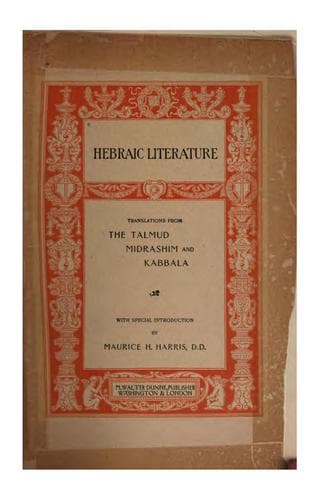
Hebraic Literature; Translations from the Talmud, Midrashim and Kabbala
Religion
Hebraic Literature; Translations from the Talmud, Midrashim and Kabbala
Hebrew literature -- Translations into English
The context of the above states a tradition current among the
Jews in reference to Titus, the destroyer of Jerusalem. It is
said that when, after taking the city, he had shamefully
violated and profaned the Temple, he took the sacred vessels of
the sanctuary, wrapped them in the veil of the holy place, and
sailed with them to Rome. At sea a storm arose and threatened to
sink the ship; upon which he was heard reflecting, "It seems the
God of these Jews has no power anywhere but at sea. Pharaoh He
drowned, and Sisera He drowned, and now He is about to drown me
also. If He be mighty, let Him go ashore and contend with me
there." Then came a voice from heaven and said, "O thou wicked
one, son of a wicked man and grandson of Esau the wicked, go
ashore. I have a creature--an insignificant one in my world--go
and fight with it."
This creature was a gnat, and is called insignificant because it
must receive and discharge what it eats by one aperture.
Immediately, therefore, he landed, when a gnat flew up his
nostrils and made its way to his brain, on which it fed for a
period of seven years. One day he happened to pass a
blacksmith's forge, when the noise of the hammer soothed the
gnawing at his brain. "Aha" said Titus, "I have found a remedy
at last;" and he ordered a blacksmith to hammer before him. To a
Gentile for this he (for a time) paid four zuzim a day, but to a
Jewish blacksmith he paid nothing, remarking to him, "It is
payment enough to thee to see thy enemy suffering so painfully."
For thirty days he felt relieved, but after, no amount of
hammering in the least relieved him. As to what happened after
his death, we have this testimony from Rabbi Phineas, the son of
Aruba: "I myself was among the Roman magnates when an inquest
was held upon the body of Titus, and on opening his brain they
found therein a gnat as big as a swallow, weighing two selas."
Others say it was as large as a pigeon a year old and weighed
two litras. Abaii says, "We found its mouth was of copper and
its claws of iron." Titus gave instructions that after his death
his body should be burned, and the ashes thereof scattered over
the surface of the seven seas, that the God of the Jews might
not find him and bring him to judgment. (_Gittin_, fol. 56, col.
2.)
Public-domain text, read in full here on John Shaqi.
Reviews
Reviews
No reviews yet
Be the first to share your thoughts on this work.
Join the Discussion
Join the discussion
Sign in to leave a comment or review.
Sign InorCreate an account