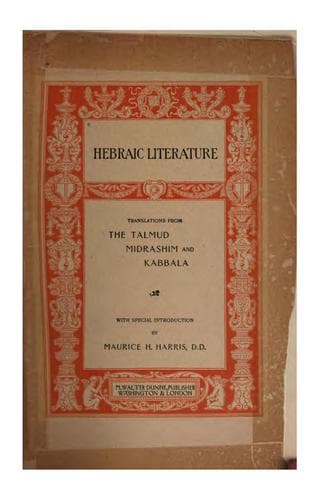
Hebraic Literature; Translations from the Talmud, Midrashim and Kabbala
Religion
Hebraic Literature; Translations from the Talmud, Midrashim and Kabbala
Hebrew literature -- Translations into English
Three dreams come to pass:--That which is dreamed in the morning; that
which is also dreamed by one's neighbor; and a dream which is
interpreted within a dream; to which some add, one that is dreamed by
the same person twice; as it is written (Gen. xli. 32), "And for that
the dream was doubled unto Pharaoh twice."
Ibid., fol. 55, col. 2.
Three things tranquilize the mind of man:--Melody, scenery, and sweet
odor. Three things develop the mind of man:--A fine house, a handsome
wife, and elegant furniture.
Ibid., fol. 57, col. 2.
The Rabbis have taught that there are three sorts of dropsy:--Thick,
resulting from sin; bloated, in consequence of insufficient food; and
thin, due to sorcery.
_Shabbath_, fol. 33, col. 1.
These three grow stronger as they grow older:--The fish, the serpent,
and the pig.
Ibid., fol. 77, col. 2.
It were better to cut the hands off than to touch the eye, or the nose,
or the mouth, or the ear, etc., with them without having first washed
them. Unwashed hands may cause blindness, deafness, foulness of breath,
or a polypus. It is taught that Rabbi Nathan has said, "The evil spirit
Bath Chorin, which rests upon the hands at night, is very strict; he
will not depart till water is poured upon the hands three times over."
Ibid. fol. 109, col. 1.
The great importance of this ceremonial washing of the hands
will appear from the following anecdote, which we quote
_verbatim_ from another part of the Talmud:--"It happened once,
as the Rabbis teach, that Rabbi Akiva was immured in a prison,
and Yehoshua Hagarsi was his attendant. One day the gaoler said
to the latter as he entered, 'What a lot of water thou hast
brought to-day! Dost thou need it to sap the walls of the
prison?' So saying, he seized the vessel and poured out half of
the water. When Yehoshua brought in what was left of the water
to Rabbi Akiva, the latter, who was weary of waiting, for he was
faint and thirsty, reproachfully said to him, 'Yehoshua, dost
thou forget that I am old, and my very life depends upon thee?'
When the servant related what had happened, the Rabbi asked for
the water to wash his hands, 'Why, master,' said Yehoshua,
'there's not enough for thee to drink, much less to cleanse thy
hands with.' To which the Rabbi replied, 'What am I to do? They
who neglect to wash their hands are judged worthy of death; 'tis
better that I should die by my own act from thirst than act
against the rules of my associates.' And accordingly it is
related that he abstained from tasting anything till they
brought him water to wash his hands." (_Eiruvin_, fol. 21, col.
2. See also _Maimonides, Hilc. Berach._, vi. 19.)
Public-domain text, read in full here on John Shaqi.
Reviews
Reviews
No reviews yet
Be the first to share your thoughts on this work.
Join the Discussion
Join the discussion
Sign in to leave a comment or review.
Sign InorCreate an account