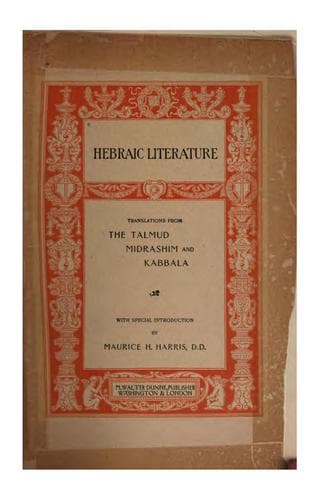
Hebraic Literature; Translations from the Talmud, Midrashim and Kabbala
Religion
Hebraic Literature; Translations from the Talmud, Midrashim and Kabbala
Hebrew literature -- Translations into English
From the context of the passage just quoted we cull the
following, which proves that the Talmud itself bases the precept
concerning the washing of hands on oral tradition and not on the
written law:--"Rav Yehudah ascribes this saying to Shemuel, that
when Solomon gave to the traditional rules that regulated the
washing of hands and other ceremonial rites the form and
sanction of law, a Bath Kol came forth and said (Prov. xxiii.
15), 'My son, if thy heart be wise, my heart shall rejoice, even
mine;' and again it said (Prov. xxvii, 11), 'My son, be wise,
and make my heart glad, that I may answer him that reproacheth
me.'" (See Prov. xxx. 5, 6.)
There is a great deal in the Talmud about washing the hands, in
addition to what is said in the treatise Yadaim, which is
entirely devoted to the subject. But this topic is subordinate
to another, namely, the alleged inferiority of the precepts of
the Bible to the prescriptions of the Rabbis, of which the
punctilious rules regulative of hand washing form only a small
fraction. This is illustrated by an anecdote from the Talmudic
leaflet entitled Callah, respecting Rabbi Akiva, whose fame
extends from one end of the world to the other. (See _Yevamoth_,
fol. 16, col. 2).
Once upon a time, as the Elders were sitting together, two lads
passed by them, one with his head covered and the other
bareheaded. Of the latter boy as he passed Rabbi Elazar said,
"He is a Mamzer," and Rabbi Yehoshua, "He is a Ben Haniddah,"
but Rabbi Akiva contended, "He is both a Mamzer and a Ben
Haniddah." Upon which the Elders said to Rabbi Akiva, "How
darest thou be so bold as dispute the assertion of thy masters?"
"Because I can substantiate what I say," was his answer. He then
went to the mother of the lad, and found her selling pease in
the market place. "Daughter," said he to her, "if thou wilt
answer all that I ask of thee, I will ensure thee a portion in
the life to come." She replied, "Let me have thy oath and I will
do so." Then taking the oath with his lips but nullifying it in
his heart, he asked her, "What sort of a son is thy lad?" She
replied, "When I entered my bridal chamber I was a Niddah, and
consequently my husband kept away from me." Thus it was found
out that the boy was a Mamzer and a Ben Haniddah; upon which the
sages exclaimed, "Great is Rabbi Akiva, for he has overcome his
masters;" and as they congratulated him they said, "Blessed be
the Lord God of Israel, who hath revealed His secret unto Akiva
the son of Joseph." Thus did the Rabbi forswear himself, and
thus did his companions compliment him on the success of his
perjury; yet the Bible says, "Thou shalt not take the name of
the Lord thy God in vain" (Exod. xx. 7), and "Keep thou far from
a falsehood" (Exod. xxiii. 7).
Public-domain text, read in full here on John Shaqi.
Reviews
Reviews
No reviews yet
Be the first to share your thoughts on this work.
Join the Discussion
Join the discussion
Sign in to leave a comment or review.
Sign InorCreate an account