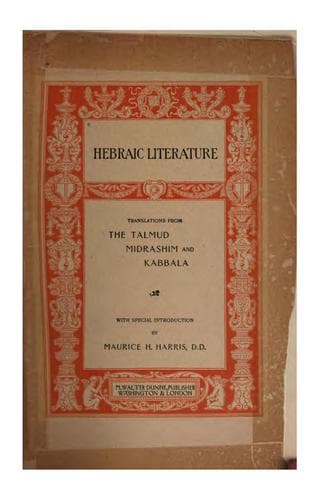
Hebraic Literature; Translations from the Talmud, Midrashim and Kabbala
Religion
Hebraic Literature; Translations from the Talmud, Midrashim and Kabbala
Hebrew literature -- Translations into English
Here is a companion picture from Yoma, fol. 84, col. 1.--"Rabbi
Yochanan was suffering from scurvy, and he applied to a Gentile
woman, who prepared a remedy for the fifth and then the sixth
day of the week. 'But what shall I do to-morrow?' said he; 'I
must not walk so far on the Sabbath.' 'Thou wilt not require any
more,' she answered. 'But suppose I do,' he replied. 'Take an
oath,' she answered, 'that thou wilt not reveal it, and I will
tell thee how to compound the remedy.' This he did in the
following words: 'By the God of Israel, I swear I will not
divulge it.' Nevertheless, when he learned the secret, he went
and revealed it. 'But was not that profaning the name of God?'
asks one. 'No,' pleads another Rabbi, 'for, as he told her
afterward, that what he meant was that he would not tell it to
the God of Israel.' The remedy was yeast, water, oil, and salt."
The anecdote that follows is from Sanhedrin, fol. 97, col
1:--"In reference to the remark of Ravina, who said, 'I used to
think that there was no truth in the world,' one of the Rabbis,
Toviah (or Tavyoomah, as some say), would protest and say, 'If
all the riches of the world were offered me, I would not tell a
falsehood.' And he used to clench his protestation with the
following apologue: 'I once went to a place called Kushta, where
the people never swerve from the truth, and where (as a reward
for their integrity) they do not die until old age; and there I
married and settled down, and had two sons born unto me. One day
as my wife was sitting and combing her hair, a woman who dwelt
close by came to the door and asked to see her. Thinking that it
was a breach of etiquette (that any one should see her at her
toilet), I said she was not in. Soon after this my two children
died, and the people came to inquire into the cause of their
premature decease. When I told them of my evasive reply to the
woman, they asked me to leave the town, lest by my misconduct I
might involve the whole community in a like calamity, and death
might be enticed to their place."
Food remains for three days in the stomach of the dog, because God knew
that his food would be scanty.
_Shabbath_, fol. 155, col. 1.
He who is born on the third day of the week will be rich and amorous.
Ibid., fol. 156, col. 1.
Public-domain text, read in full here on John Shaqi.
Reviews
Reviews
No reviews yet
Be the first to share your thoughts on this work.
Join the Discussion
Join the discussion
Sign in to leave a comment or review.
Sign InorCreate an account