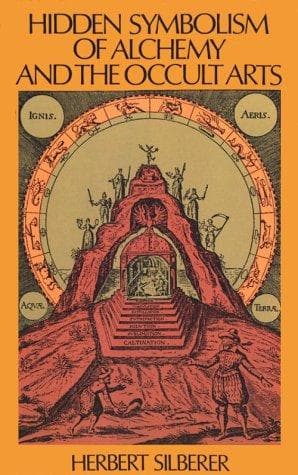
Hidden Symbolism of Alchemy and the Occult ArtsSilberer, Herbert
Religion
Hidden Symbolism of Alchemy and the Occult Arts
Silberer, Herbert
Alchemy; Society of Rosicrucians; Symbolism (Psychology)
Connections will be developed with religious and ethical topics, and we
shall have to take into account the historical and psychological relations
of hermetic thought with rosicrucianism in its various forms, and
freemasonry. And when we begin, at the conclusion of the analytical
section of my work, to apply to the solution of our parable and of several
folk tales the insight we have gained, we shall be confronted with a
problem in which we shall face two apparently contradictory
interpretations, according to whether we follow the lead of psychoanalysis
or of the hermetic, hieroglyphic solution. The question will then arise
whether and how the contradiction occurs. How shall we bring into relation
with each other and reconcile the two different interpretations which are
quite different and complete in themselves?
The question arising from the several illustrations expands into a general
problem, to which the synthetic part of my book is devoted. This will,
among other considerations, lead us into the psychology of symbol-making
where again the discoveries of psychoanalysis come to our aid. We shall
not be satisfied with analysis, but endeavor to follow up certain
evolutionary tendencies which, expressed in psychological symbols,
developing according to natural laws, will allow us to conjecture a
spiritual building up or progression that one might call an anabasis. We
shall see plainly by this method of study how the original contradiction
arises and how what was previously irreconcilable, turns out to be two
poles of an evolutionary process. By that means, several principles of
myth interpretation will be derived.
I have just spoken of an anabasis. By that we are to understand a forward
movement in a moral or religious sense. The most intensive exemplar of the
anabasis (whatever this may be) is mysticism. I can but grope about in the
psychology of mysticism; I trust I may have more confidence at that point
where I look at its symbolism from the ethical point of view.
Section II.
Dream And Myth Interpretation.
[Readers versed in Freud’s psychoanalysis are requested to pass over this
chapter as they will find only familiar matter.]
In the narrative which we have just examined its dream-like character is
quite noticeable. On what does it depend? Evidently the Parable must bear
marks that are peculiar to the dream. In looking for correspondences we
discover them even upon superficial examination.
Public-domain text, read in full here on John Shaqi.
Reviews
Reviews
No reviews yet
Be the first to share your thoughts on this work.
Join the Discussion
Join the discussion
Sign in to leave a comment or review.
Sign InorCreate an account