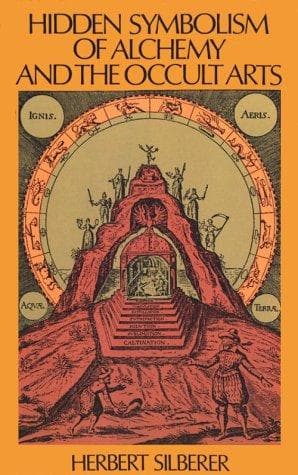
Hidden Symbolism of Alchemy and the Occult ArtsSilberer, Herbert
Religion
Hidden Symbolism of Alchemy and the Occult Arts
Silberer, Herbert
Alchemy; Society of Rosicrucians; Symbolism (Psychology)
A definite group of such repressed primal impulses is given a prominent
place by psychoanalysis. I refer to the so-called Œdipus complex that
plays an important rôle in the dream life as also in myth and apparently,
also in creative poetry. The fables (sagas, dramas) of Œdipus, who slays
his father and marries his mother are well known. According to the
observations of psychoanalysis there is a bit of Œdipus in every one of
us. [These Œdipus elements in us can—as I must observe after reading
Imago, January, 1913—be called “titanic” in the narrower sense, following
the lead of Lorenz. They contain the motive for the separation of the
child from the parents.] The related conflicts, that in their entirety
constitute the Œdipus complex (almost always unconscious, because actively
repressed) arise in the disturbance of the relation to the parents which
every child goes through more or less in its first (and very early) sexual
emotions. “If king Œdipus can deeply affect modern mankind no less than
the contemporary Greeks, the explanation can lie only in the fact that the
effect of the Greek tragedy does not depend on the antithesis between fate
and the human will, but in the peculiarity of the material in which this
antithesis is developed. There must be a voice in our inner life which is
ready to recognize the compelling power of fate in the case of Œdipus,
while we reject as arbitrary the situations in the Ahnfrau or other
destiny tragedies. And such an element is indeed contained in the history
of king Œdipus. His fate touches us only because it might have been ours,
because the oracle hung the same curse over us before our birth as over
him. For us all, probably, it is ordained that we should direct our first
sexual feelings towards our mothers, the first hate and wish for violence
against our fathers. Our dreams convince us of that. King Œdipus, who has
slain his father Laius and married his mother Jocasta, is only the
wish-fulfillment of our childhood. But more fortunate than he, we have
been able, unless we have become psychoneurotic, to dissociate our sexual
feelings from our mothers and forget our jealousy of our fathers. From the
person in whom that childish wish has been fulfilled we recoil with the
entire force of the repressions, that these wishes have since that time
suffered in our inner soul. While the poet in his probing brings to light
the guilt of Œdipus, he calls to our attention our own inner life, in
which that impulse, though repressed, is always present. The antithesis
with which the chorus leaves us
See, that is Œdipus,
Who solved the great riddle and was peerless in power,
Whose fortune the townspeople all extolled and envied.
See into what a terrible flood of mishap he has sunk.
Public-domain text, read in full here on John Shaqi.
Reviews
Reviews
No reviews yet
Be the first to share your thoughts on this work.
Join the Discussion
Join the discussion
Sign in to leave a comment or review.
Sign InorCreate an account