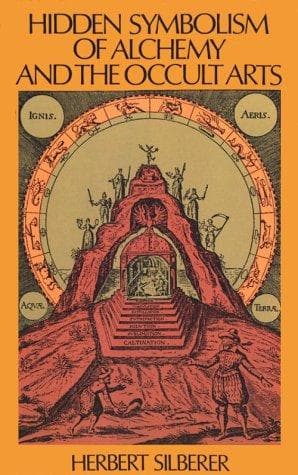
Hidden Symbolism of Alchemy and the Occult ArtsSilberer, Herbert
Religion
Hidden Symbolism of Alchemy and the Occult Arts
Silberer, Herbert
Alchemy; Society of Rosicrucians; Symbolism (Psychology)
This admonition hits us and our pride, we who have become in our own
estimation, since the years of childhood, so wise and so mighty. Like
Œdipus, we live in ignorance of the wishes that are so offensive to
morality, which nature has forced upon us, and after their disclosure we
should all like to turn away our gaze from the scenes of our childhood.”
(Freud, Trdtg., p. 190 f.)
Believing that I have by this time sufficiently prepared the reader who
was unfamiliar with psychoanalysis for the psychoanalytic part of my
investigation, I will dispense with further time-consuming explanations.
Part II.
ANALYTIC PART.
Section I.
Psychoanalytic Interpretation Of The Parable.
Although we know that the parable was written by a follower of the
hermetic art, and apparently for the purpose of instruction, we shall
proceed, with due consideration, to pass over the hermetic content of the
narrative, which will later be investigated, and regard it only as a play
of free fantasy. We shall endeavor to apply to the parable knowledge
gained from the psychoanalytic interpretation of dreams, and we shall find
that the parable, as a creation of the imagination, shows at the very
foundations the same structure as dreams. I repeat emphatically that in
this research, in being guided merely by the psychoanalytic point of view,
we are for the time being proceeding in a decidedly one-sided manner.
In the interpretation of the parable we cannot apply the original method
of psychoanalysis. This consists in having a series of seances with the
dreamer in order to evoke the free associations. The dreamer of the
parable—or rather the author—has long ago departed this life. We are
obliged then to give up the preparatory process and stick to the methods
derived from them. There are three such methods.
The first is the comparison with typical dream images. It has been shown
that in the dreams of all individuals certain phases and types continually
recur, and in its symbolism have a far reaching general validity, because
they are manifestly built on universal human emotions. Their imaginative
expression is created according to a psychical law which remains fairly
unaffected by individual differences.
The second is the parallel from folk psychology. The inner affinity of
dream and myth implies that for the interpretation of individual creations
of fancy, parallels can profitably be drawn from the productions of the
popular imagination and vice versa.
Public-domain text, read in full here on John Shaqi.
Reviews
Reviews
No reviews yet
Be the first to share your thoughts on this work.
Join the Discussion
Join the discussion
Sign in to leave a comment or review.
Sign InorCreate an account