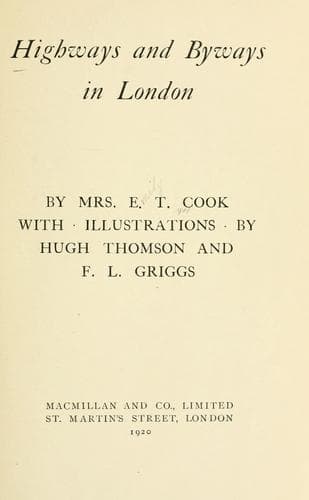
Highways and Byways in LondonCook, Emily Constance Baird
History
Highways and Byways in London
Cook, Emily Constance Baird
London (England) -- Description and travel
"In this church is a curious 'Pedlar's Window,' with a
romantic story attached to it. When the church was founded,
it is said that a pedlar left an acre of land to the parish,
on condition that a picture of himself, his pack and his
dog, should be preserved in the church. This was accordingly
done; the pedlar was commemorated in the glass of the
window, and the value of the acre, at first 2_s._ 8_d._,
increased till in our day it is worth £1000 a year. In 1884,
some local iconoclasts actually removed the pedlar from the
window, to put up modern glass to the relatives of certain
officials. Popular indignation, however, has since
reinstated the injured pedlar, with his pack and dog, in
their place."
But Lambeth, however charming and historic, is still "the Surrey
Side", and the glories of the Albert Embankment pale before those of
the Victoria Embankment, one of the greatest London improvements of
the century. Of course it has its critics,--of the order who cavil at
the poor Romans for embanking their devastating yellow Tiber. But it
is the fashion for us to abuse our London monuments, and to deride
them as the work of a "nation of shopkeepers." The Londoner rarely
approves of anything new or even modern. Of the Chelsea Embankment,
all that Mr. Hare says is that "it has robbed us of the water stairs
to the Botanic Garden, given by Sir Hans Sloane." Does not even Mr.
Ruskin fall foul of the innumerable straight lines of the Palace of
Westminster, and of its stately Clock Tower, as testifying to the sad
want of imagination shown by the modern English architect? (But Mr.
Ruskin must surely that day have been in search for a windmill to tilt
against, for the abused "straight lines" do not prevent this being one
of the loveliest of London views.) And does not M. Taine pour the
vials of his wrath on to the great river Palace of Somerset House,
with its "blackened porticoes filled with soot"? "Poor Greek
architecture," he adds compassionately, "what is it doing in such a
climate?" Evidently the idea of the artistic value of soot, to which I
have already alluded, had not occurred to him.
Public-domain text, read in full here on John Shaqi.
Reviews
Reviews
No reviews yet
Be the first to share your thoughts on this work.
Join the Discussion
Join the discussion
Sign in to leave a comment or review.
Sign InorCreate an account