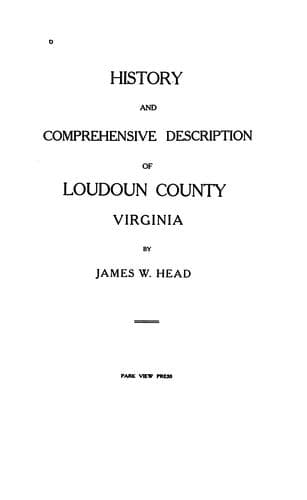
History and Comprehensive Description of Loudoun County, VirginiaHead, James William
History
History and Comprehensive Description of Loudoun County, Virginia
Head, James William
Loudoun County (Va.) -- History
"Immediately at the western base of the Catoctin Mountain, a range of
magnesian or talcose slates occur traversing its whole length.... In
this range a vein of magnesian limestone is met with, and is exposed
in several places. It however is narrow, in some places only a few
feet in thickness, and being difficult to obtain is not much sought
after for burning."
* * * * *
"Along the eastern side of the valley (Loudoun) gneiss is frequently
met with on the surface, and where the larger streams have worn deep
valleys, it is sometimes exposed in high and precipitous cliffs. This
is more particularly the case along Goose Creek and Beaver Dam.
Associated with it, however, is clay slate, not so much in rock as in
soil, for it being more readily decomposed is seldom found on the
surface, except as soil. These two varieties are often met with side
by side in thin layers, and their combination at the surface forms a
peculiarly favorable soil for agricultural purposes. The gneiss from
the quartz it contains makes a sandy soil, while the clay slate gives
it tenacity. This happy combination is a prevailing feature of this
entire valley, and renders it one of the best farming sections in
Virginia.
"Another rock that is a valuable acquisition is hornblende. This kind
when first taken from the ground, is always covered as with a coat of
rust. This is doubtless the fact, for the oxydasion of the iron it
contains gives it that appearance, and colors the soil a reddish hue
in its immediate vicinity. Wherever this rock abounds, the soil is
durable and the crops are usually heavy. It is sometimes met with
having a fine grain, and so very hard as to be almost brittle, though
generally very difficult to break, and when broken strongly resembling
cast-iron, and will sometimes ring, on being struck, almost as
clearly. It was used very much formerly for making journals to run
mill-gudgeons upon. When found on the surface, it is usually of a
rounded form...."
However, much of the rock of the valley partakes of the nature of both
hornblend and gneiss, and has been aptly termed a "hornblend gneiss
rock."
Beds of magnesian or talcose slate, sometimes containing crystals of
sulphuret of iron, are frequently met with in this section, and at the
base of Black Oak Ridge, which is composed chiefly of chlorite slate
and epidote, another bed of magnesian limestone is found. Containing
about 40 per cent of magnesia, it makes an excellent cement for walls,
but is of little or no value as a fertilizer.
SOILS.[10]
The soils of Loudoun vary greatly in both geological character and
productiveness, every variety from a rich alluvial to an unproductive
clay occurring within her boundaries. In general the soils are deep
and rich and profitably cultivated.
Public-domain text, read in full here on John Shaqi.
Reviews
Reviews
No reviews yet
Be the first to share your thoughts on this work.
Join the Discussion
Join the discussion
Sign in to leave a comment or review.
Sign InorCreate an account