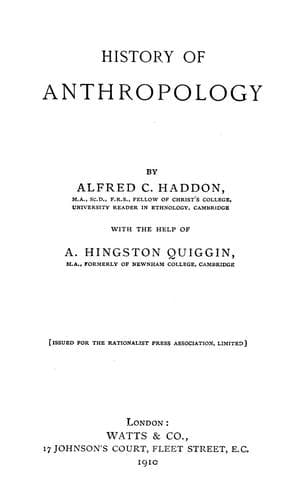
History of anthropologyHaddon, Alfred C. (Alfred Cort)
History
History of anthropology
Haddon, Alfred C. (Alfred Cort)
Anthropology -- History
Despite all the labour that has been bestowed on the subject,
craniometric literature is at present as unsatisfactory as it
is dull. Hitherto observations have been concentrated on
cranial measurements as methods for the discrimination of the
skulls of different races. Scores of lines, arcs, chords, and
indexes have been devised for this purpose, and the diagnosis
of skulls has been attempted by a process as mechanical as
that whereby we identify certain issues of postage-stamps by
counting the nicks in the margin. But there is underlying all
these no unifying hypothesis; so that when we, in our
sesquipedalian jargon, describe an Australian skull as
microcephalic, phænozygous, tapeino-dolichocephalic,
prognathic, platyrhine, hypselopalatine, leptostaphyline,
dolichuranic, chamaeprosopic, and microseme, we are no nearer
to the formulation of any philosophic concept of the general
principles which have led to the assumption of these
characters by the cranium in question, and we are forced to
echo the apostrophe of Von Török, “Vanity, thy name is
Craniology.”
It is significant that so many of the earlier craniologists recognised
that the really important problem before them was to gain a knowledge of
the size and relative proportions of the various regions of the brain,
this being a direct result of the phrenological studies then so much in
vogue. When phrenology became discredited, this aspect of craniometry
was largely neglected; but recently it has exhibited signs of a healthy
revival, and the inner surface of the cranium is now regarded as more
instructive than the outer.
Though for a time craniology was hailed as the magic formula by which
alone all ethnological tangles could be unravelled, measurements of
other parts of the body were not ignored by those who recognised that no
one measurement was sufficient to determine racial affinities.
[Sidenote: =Anthropometry.=]
Thus Anthropometry began to map out definite lines of research, and
detailed studies were made of arms and legs, hands and feet, curves and
angles, brains and viscera; while, shorn of its extravagant claims,
craniology took its legitimate place as one in a series of bodily
measurements. One of the earliest workers in measurements other than
that of the skull was Charles White (1728-1813).
His contribution to Somatology was a series of measurements on arms; and
he discovered that the fore-arm of the Negro is longer, in comparison
with his upper-arm, than that of the European, and that that of the Ape
is relatively longer than that of the Negro. On account of these
measurements on the living (no less than fifty Negroes were measured),
White has been claimed as the founder of Anthropometry. Soemmerring
(1755-1830), however, had made use of measurements in his comparison of
the anatomy of the Negro with the European.
[Sidenote: =Measurements and Observations of Living Populations.=]
Public-domain text, read in full here on John Shaqi.
Reviews
Reviews
No reviews yet
Be the first to share your thoughts on this work.
Join the Discussion
Join the discussion
Sign in to leave a comment or review.
Sign InorCreate an account