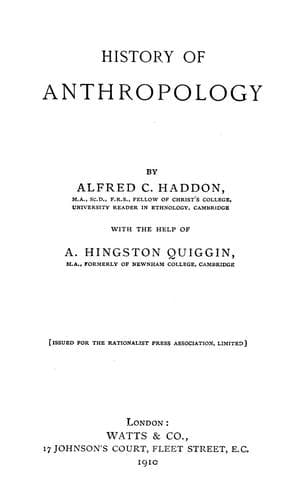
History of anthropologyHaddon, Alfred C. (Alfred Cort)
History
History of anthropology
Haddon, Alfred C. (Alfred Cort)
Anthropology -- History
About the middle of the nineteenth century observations on the living
were made, in addition to Anthropometry; investigations were undertaken,
not of the skulls and bones of the dead, or even of the head-forms and
body-measurements of the living, but of the forms of such features as
the nose and ear, pigmentation of the skin and eyes, and the like. As
early as 1834 L. R. Villermé had started investigations on the various
classes of the population of Great Britain, comparing the dwellers in
the country with those of manufacturing districts and large cities,
mainly in the interests of hygiene; and later he examined the size and
health of children working in coal-mines.
In 1861 the venerated Dr. John Beddoe published a study of hair and eye
colour in Ireland, and he has continued his researches in this fruitful
field from time to time in various parts of the British Isles, and to a
less extent on the continent of Europe.
But it was on the continent that this method of investigation was most
ardently prosecuted; and the story of its political origin may here be
briefly recounted, since the results were of great service to the
science of Anthropometry.
During the bombardment of Paris, in the Franco-Prussian War, the Natural
History Museum suffered some damage through shells; and soon afterwards
the director, de Quatrefages, published a pamphlet on _La Race
Prussienne_ (1871). This was to show that the Prussians were not
Teutonic at all, but were descended from the Finns, who were classed
with the Lapps as alien Mongolian intruders into Europe. They were thus
mere barbarians, with a hatred of a culture they could not appreciate;
and their object in shelling the museum was “to take from this Paris
that they execrate, from this Babylon that they curse, one of its
elements of superiority and attraction. Hence our collections were
doomed to perish.” A reply was made by Professor Virchow, of Berlin, and
the battle raged furiously. The significance of this controversy to
Anthropometry lies in the fact that its immediate result was an order
from the German Government authorising an official census of the colour
of the hair and eyes of 6,000,000 school children of the Empire—a census
which served at once as a stimulus to and a model for further
investigators.
This census had some amusing and unexpected results, quoted by Dr.
Tylor[29] as illustrating the growth of legends:—
Footnote 29:
Pres. Add. Brit. Ass., 1879.
Public-domain text, read in full here on John Shaqi.
Reviews
Reviews
No reviews yet
Be the first to share your thoughts on this work.
Join the Discussion
Join the discussion
Sign in to leave a comment or review.
Sign InorCreate an account