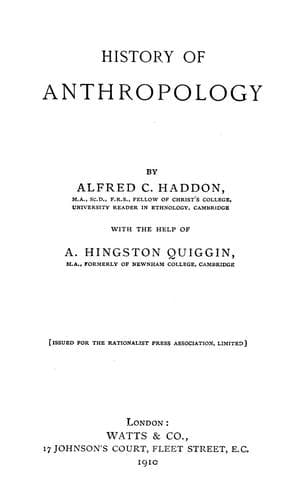
History of anthropologyHaddon, Alfred C. (Alfred Cort)
History
History of anthropology
Haddon, Alfred C. (Alfred Cort)
Anthropology -- History
No doubt many legends of the ancient world, though not really
history, are myths which have arisen by reasoning on actual
events, as definite as that which, some four years ago, was
terrifying the peasant mind in North Germany, and especially in
Posen. The report had spread far and wide that all Catholic
children with black hair and blue eyes were to be sent out of
the country, some said to Russia; while others declared that it
was the King of Prussia who had been playing cards with the
Sultan of Turkey, and had staked and lost 40,000 fair-haired,
blue-eyed children; and there were Moors travelling about in
covered carts to collect them; and the schoolmasters were
helping, for they were to have five dollars for every child they
handed over. For a time popular excitement was quite serious;
the parents kept their children away from school and hid them,
and when they appeared in the streets of the market town the
little ones clung to them with terrified looks.... One
schoolmaster, who evidently knew his people, assured the
terrified parents that it was only the children with blue hair
and green eyes that were wanted—an explanation that sent them
home quite comforted.
Observations of external characters, combined with precise measurements,
have now been made on a large scale in most European countries, and
these methods are adopted on anthropological expeditions. In this way a
great deal of valuable material for study has been accumulated, but much
work remains to be done in this direction.
[Sidenote: =Methods of Dealing with Anthropometric Data.=]
Not only have head, body, and limb measurements been recorded, but the
device of an “index” has been adopted which gives the ratio between two
measurements, as, for example, in the previously-mentioned cephalic
index (p. 34). The averages or means of series of indices obtained from
one people have been compared with those obtained from other peoples;
but this method is misleading, as there is frequently a very
considerable range in any given series, and a mean merely gives a
colourless conception of racial types, the only value of which is a
ready standard of comparison, which, however, is full of pitfalls.
A further step in the advancement of anthropometric research was made
when the extent and frequency of such deviations from the mean were
recorded. At first this was done in a tabular manner by means of
seriations; then curves were employed: a single peak was held to
indicate purity of race, double peaks that two racial elements entered
into the series measured, a broad peak or plateau was interpreted as
being due to race fusion. Dr. C. S. Myers,[30] who has discussed these
and other methods, points out the fallacies of this interpretation,
saying: “There can be little doubt that most of the many-peaked curves
owe their irregularity to the inadequate number of individual
measurements which have been taken.”
Public-domain text, read in full here on John Shaqi.
Reviews
Reviews
No reviews yet
Be the first to share your thoughts on this work.
Join the Discussion
Join the discussion
Sign in to leave a comment or review.
Sign InorCreate an account