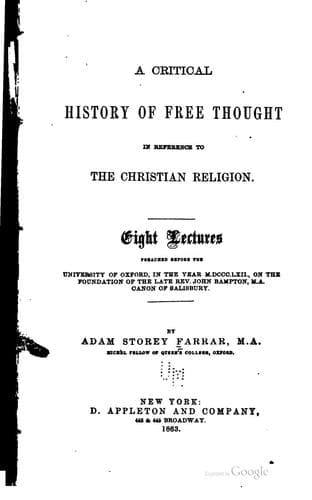
History of Free Thought in Reference to The Christian ReligionFarrar, Adam Storey
History
History of Free Thought in Reference to The Christian Religion
Farrar, Adam Storey
Free thought -- History
It is hard to persuade the students of a past generation that the historic
mode of approaching any problem is the first step toward its successful
solution. Yet a little reflection may at least make the meaning of the
assertion understood. If we view the literary characteristic of the
present, in comparison with that of past ages, we are perhaps right in
stating, that its peculiar feature is the prevalence of the method of
historical criticism. If the four centuries since the Renaissance be
considered, the critical peculiarity of the sixteenth and seventeenth will
be found to be the investigation of ancient literature; in the former
directed to _words_, in the latter to _things_. The eighteenth century
broke away from the past, and, emancipating itself from authority, tried
to rebuild truth from its foundations from present materials, independent
of the judgment formed by past ages. The nineteenth century unites both
methods. It ventures not to explore the universe, unguided by the
experience of the past; but, while reuniting itself to the past, it does
not bow to it. It accepts it as a fact, not as an authority. The
seventeenth century worshipped the past; the eighteenth despised it: the
nineteenth mediates, by means of criticism. Accordingly, in literary
investigations at present, each question is approached from the historic
side, with the belief that the historico-critical inquiry not only
gratifies curiosity, but actually contributes to the solution of the
problem. Some indeed assert(21) this, because they think that the historic
study of philosophy is the whole of philosophy; and, believing that all
truth is relative to its age, are hopeless of attaining the absolute and
unaltering solution of any problem. We, on the other hand, are content to
believe that the history of philosophy is only the entrance to philosophy.
But in either case, truth is sought by means of a philosophical history of
the past; which, tracking the progress of truth and error in any
particular department, lays bare the natural as well as the literary
history; the causes of the past, as well as its form. Truth and error are
thus discovered, not by breaking with the past, and using abstract
speculations on original data, but by tracing the growth of thought,
gathering the harvest of past investigations, and learning by experience
to escape error.
These considerations bear upon the present subject in this manner: they
show not only the special adaptation to the passing tastes of the age, of
an historic mode of approaching a subject, but exhibit also that the mode
of proof and of refutation must be sought, not on abstract grounds, but
historic. The position of an enemy is not to be forced, but turned; his
premises to be refuted, not his conclusions; the antecedent reasons which
led him into his opinion to be exhibited, not merely evidence offered of
the fact that he is in error.
Public-domain text, read in full here on John Shaqi.
Reviews
Reviews
No reviews yet
Be the first to share your thoughts on this work.
Join the Discussion
Join the discussion
Sign in to leave a comment or review.
Sign InorCreate an account