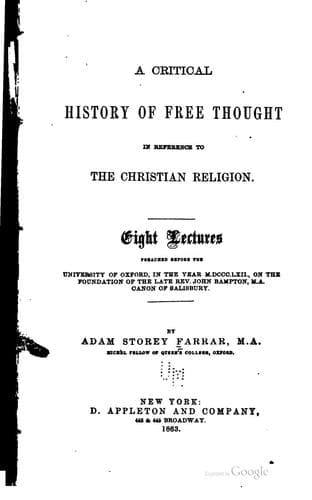
History of Free Thought in Reference to The Christian Religion — John Shaqi
History of Free Thought in Reference to The Christian ReligionFarrar, Adam Storey
History
History of Free Thought in Reference to The Christian Religion
Farrar, Adam Storey
Free thought -- History
This view, that doubt might be refuted by the historic analysis of its
operation, by laying bare the antecedent grounds which had produced it,
will explain why the author was led to believe that a chapter of mental
and moral physiology might be useful, which would not merely carry out the
anatomy of actual forms of disease, but discover their origin by the study
of the preceding natural history of the patients.
These remarks will perhaps suffice for explaining the object which was
proposed in writing this history; and may justify the hope that this work,
thus adapted to the wants of the time, may offer such a contribution to
the subject of the Christian evidences, as not only to possess an
intellectual value, but to coincide with the purpose contemplated by the
founder of the Lectures.
It remains to state the sources which have been used for the literary
materials of the history. Though they are sufficiently indicated in the
notes, a general description of them may be useful.
They may be distributed under four classes;
1. The histories which have been professedly devoted to the subject.
2. The notices of the history of unbelief in general histories of the
church or of literature.
3. (Which ought indeed to rank first in importance;) the original
authorities for the facts, i.e. the works of the sceptical writers
themselves; or of the contemporary authors who have refuted them.
4. The monographs, which treat of particular writers, ages, or schools, of
sceptical thought.
In approaching the subject, a student would probably commence with the
first two classes; and after having thus acquired for himself a _carte du
pays_, would then explore it in detail by the aid of the third and fourth.
1. The works which have professedly treated of the history of infidelity,
as a whole, are not of great importance.
One of the earliest was the _Historia Univ. Atheismi_, 1725, of Reimannus;
and the _De Atheismo_, 1737, of Buddeus. (An explanation of the word
_Atheism_, as employed by them, is given in Note 21. p. 413.) hey furnish,
as the name implies, a history of scepticism, as well as of sceptics; yet,
though the labours of such diligent and learned men can never be useless,
they afford little information now available. Their date also necessarily
precluded them from knowing the more recent forms of unbelief. Perhaps
under this head we ought also to name the chapters on polemical theology
in the great works of bibliography of the German scholars of the same
time, such as Pfaff (_Hist. Litt. Thol._); Buddeus (_Isagoge_); Fabricius
(_Delectus Argum._); Walch’s (_Biblical Theol. Select._); which contain
lists of sceptical works, either directly, or indirectly by naming the
apologists who have answered them. The references to these works will be
found in Note 39. p. 436.
Public-domain text, read in full here on John Shaqi.
Reviews
Reviews
No reviews yet
Be the first to share your thoughts on this work.
Join the Discussion
Join the discussion
Sign in to leave a comment or review.
Sign InorCreate an account