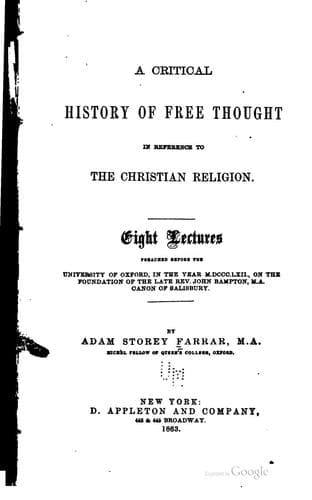
History of Free Thought in Reference to The Christian Religion — John Shaqi
History of Free Thought in Reference to The Christian ReligionFarrar, Adam Storey
History
History of Free Thought in Reference to The Christian Religion
Farrar, Adam Storey
Free thought -- History
The explanation also of the further question concerning the object which
the writer proposed to effect, by the treatment of such a subject in a
course of Bampton Lectures, is given so fully elsewhere, that a few words
may here suffice in reference to it.(20) Experience of the wants of
students in this time of doubt and transition, which those who are
practically acquainted with the subject will best understand, as well as
observation of the tone of thought expressed in our sceptical literature,
led him to believe that a history, natural as well as literary, of doubt;
an analysis of the forms and a statement of the intellectual causes of it,
would have a value, direct and indirect, in many ways. His desire, he is
willing to confess, was to guide the student, rather than to refute the
unbeliever. He did not expect to furnish the combatant with ready-made
weapons, which would make him omnipotent in conflict; but he hoped to give
him some suggestions in reference to the tactics for conducting the
contest. The Lectures have a polemical aspect, but they seek to obtain
their end by means of the educational. The writer has aimed at assisting
the student, in the struggle with his doubts, in the inquiry for truth, in
the quiet meditative search for light and knowledge, preparatory to
ministering to others. The survey of a new region, which ordinary works on
the history of infidelity rarely touch, may lay bare unsuspected or
undetected causes of unbelief; and thus indirectly offer a refutation of
it; for intellectual error is refuted, when the origin of it is referred
to false systems of thought. The anatomy of error is the first step to its
cure.
In another point of view, independently of the value of the line of
inquiry generally, and the special suitability of it to individual minds,
there is a further use, which in the present day belongs to it in common
with all inquiries into the history of thought.
Public-domain text, read in full here on John Shaqi.
Reviews
Reviews
No reviews yet
Be the first to share your thoughts on this work.
Join the Discussion
Join the discussion
Sign in to leave a comment or review.
Sign InorCreate an account