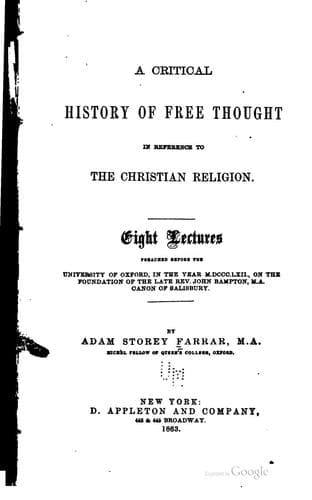
History of Free Thought in Reference to The Christian Religion — John Shaqi
History of Free Thought in Reference to The Christian ReligionFarrar, Adam Storey
History
History of Free Thought in Reference to The Christian Religion
Farrar, Adam Storey
Free thought -- History
Among French writers, the only one of importance is Houtteville, who
prefixed an Introduction to his work, _La Religion Chrétienne prouvée par
des faits_, 1722, containing an account of the writers for and against
Christianity from the earliest times. (Translated 1739.) It contains
little information concerning the authors or the events, but a clearly and
correctly written analysis of their works and thoughts.
Among the English writers who have attempted a consecutive history of the
whole subject was Van Mildert, afterwards bishop of Durham, who has been
already named. The first volume of his _Boyle Lectures_, in 1802-4, was
devoted to the history of infidelity; the second to a general statement of
the evidences for Christianity. This work, on account of its date,
necessarily stops short before the existence of modern forms of doubt; and
indeed evinces no knowledge concerning the contemporary forms of
literature in Germany, which had already attracted the attention of Dr.
Herbert Marsh. The point of view of the work, as already described, almost
entirely precludes the author from entering upon the analysis of the
causes, either emotional or intellectual, which have produced unbelief.
Its value accordingly is chiefly in the literary materials collected in
the notes; in which respect it bears marks of careful study. Though mostly
drawn from second-hand sources, it exhibits wide reading and thoughtful
judgment.
A portion of the Bampton Lectures for 1852, by the Rev. J. C. Riddle, was
devoted to the subject of infidelity. The author’s object, as the
title(22) implies, was to give the natural history of unbelief, to the
neglect of the literary. Psychological rather than historical analysis was
used by him for the investigation; and his examination of the moral causes
of doubt is better than of the intellectual. The notes contain a
collection of valuable quotations, which supplement those of Van Mildert,
but are unfortunately given, for the most part, without references.
This completes(23) the enumeration of the histories professedly devoted to
infidelity, with the exception of a small but very creditable production
published since several of these lectures were written, _Defence of the
Faith; Part I. Forms of Unbelief_, by the Rev. S. Robins, forming the
first part of a work, of which the second is to treat the evidences; the
third to draw the moral. It does not profess to be a very deep work;(24)
but it is interesting; drawn generally from the best sources, and written
in an eloquent style and devout spirit.
2. The transition is natural from these works, which treat of the history
of unbelief or give lists of the works of unbelievers, to the notices of
sceptical writers contained in general histories of the church or of
literature.
Public-domain text, read in full here on John Shaqi.
Reviews
Reviews
No reviews yet
Be the first to share your thoughts on this work.
Join the Discussion
Join the discussion
Sign in to leave a comment or review.
Sign InorCreate an account