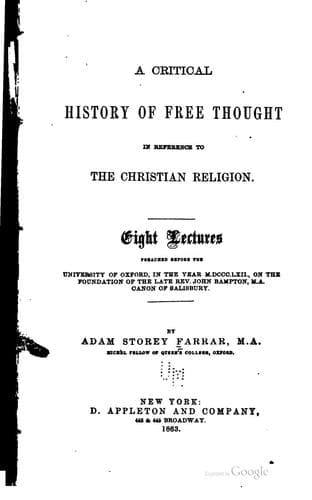
History of Free Thought in Reference to The Christian ReligionFarrar, Adam Storey
History
History of Free Thought in Reference to The Christian Religion
Farrar, Adam Storey
Free thought -- History
I. Its rise traced, 1640-1700. (pp. 119-125.) In this period the religious
inquiry has a political aspect, as seen (1) in Lord Herbert of Cherbury
(_De Veritate_ and _Religio Laici_) in the reign of Charles I. (pp. 119,
120.) (2) In Hobbes’s _Leviathan_. (pp. 121, 122.) (3) In Blount (_Oracles
of Reason_, and _Life of Apollonius_), in the reign of Charles II., in
whom a deeper political antipathy to religion is seen. (pp. 123, 124.)
II. The maturity of Deism (1700-1740), pp. 125-144. This period includes
(p. 127):
1. The examination of the first principles of religion, on its doctrinal
side, in Toland’s _Christianity not Mysterious_, &c. (pp. 126-130.) 2.
Ditto, on its ethical side, in Lord Shaftesbury. (pp. 130, 131.) 3. An
attack on the external evidences, viz. On prophecy, by Collins, _Scheme of
Literal Prophecy_, &c. (pp. 132-136). On Miracles, by Woolston,
_Discourses on Miracles_. (pp. 136-138); and by Arnobius. (p. 143.) 4. The
substitution of natural religion for revealed, in Tindal, _Christianity as
old as the Creation_. (pp. 138-140.), in Morgan, _Moral Philosopher_. (pp.
140, 141.), and in Chubb, Miscellaneous Works. (pp. 142, 143.)
III. The decline of Deism, 1740-1760. (pp. 144-153): 1. in Bolingbroke, a
combined view of deist objections. (pp. 143-147.) 2. in Hume, an assault
on the evidence of testimony, which substantiates miracles. (pp. 147-153.)
Remarks on the peculiarities of Deism, the intellectual causes which
contributed to produce it (pp. 154, 155); and a comparison of it with the
unbelief of other periods. (p. 156.)
Estimate of the whole period; and consideration of the intellectual and
spiritual means used for repelling unbelief in it (pp. 157-161); the
former in the school of evidences, of which Butler is the type, the
mention of whom leads to remarks on his _Analogy_ (pp. 157-159); and the
latter in spiritual labours like those of Wesley. (pp. 160, 161.)
Lecture V.
_Infidelity in France in the eighteenth century; and unbelief in England
subsequent to 1760._
INFIDELITY IN FRANCE (pp. 163-194).—This is the second phase of unbelief
in the fourth crisis of faith.
Sketch of the state of France, ecclesiastical, political (pp. 164, 165,)
and intellectual (partly through the philosophy of Condillac, pp. 166,
167), which created such a mental and moral condition as to allow unbelief
to gain a power there unknown elsewhere.—The unbelief stated to be caused
chiefly by the influence of English Deism, transplanted into the soil thus
prepared. (p. 203.)
Public-domain text, read in full here on John Shaqi.
Reviews
Reviews
No reviews yet
Be the first to share your thoughts on this work.
Join the Discussion
Join the discussion
Sign in to leave a comment or review.
Sign InorCreate an account