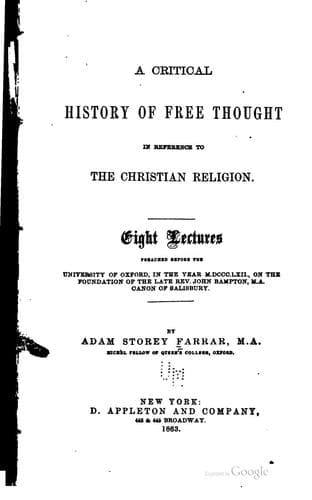
History of Free Thought in Reference to The Christian ReligionFarrar, Adam Storey
History
History of Free Thought in Reference to The Christian Religion
Farrar, Adam Storey
Free thought -- History
The history studied (1) in its assault on the Church; as seen in Voltaire;
the analysis of whose character is necessary, because his influence was
mainly due to the teacher, not the doctrine taught. (pp. 169-176.) (2) in
the transition to an assault on the State, in Diderot, (pp. 179, 180); the
philosophy of the Encyclopædists (p. 177); Helvetius (p. 180); and
D’Holbach. (p. 181.) (3) in the attack on the State, in Rousseau (pp.
183-187).—Analysis of the _Emile_ for his views on religion, (p. 185), and
comparison with Voltaire. (p. 188.) (4) in the Revolution, both the
political movement and blasphemous irreligion (pp. 188, 189); and the
intellectual movement in Volney (Analysis of the _Ruines_, pp. 191, 192).
Estimate of the period (pp. 193, 194).
UNBELIEF IN ENGLAND, from 1760 to a date a little later than the end of
the century (pp. 194-209), continued from Lecture IV.
These later forms of it stated to differ slightly from the former, by
being partially influenced by French thought. (p. 195.)
The following instances of it examined:
(1) Gibbon viewed as a writer and a critic on religion (pp. 196-199). (2)
T. Paine: account of his _Age of Reason_ (pp. 199-201). (3) The socialist
philosophy of R. Owen (p. 202). (4) The scepticism in the poetry of Byron
and Shelley (pp. 203-207).
The last two forms of unbelief, though occurring in the present century,
really embody the spirit of the last.
Statement of the mode used to meet the doubt in England during this
period. Office of the Evidences (pp. 207-209).
Lecture VI.
_Free Thought in the Theology of Germany, from 1750-1835._
This is the third phase of free thought in that which was called the
fourth crisis of faith.—Importance of the movement, which is called
“rationalism,” as the theological phase of the literary movement of
Germany (p. 210).—Deviation from the plan previously adopted, in that a
sketch is here given of German theological inquiry generally, and not
merely of unbelief (p. 211).
Brief preliminary sketch of German theology since the Reformation. Two
great tendencies shown in it during the seventeenth century (p. 211).
(1) The dogmatic and scholastic, science without earnestness (p. 212). (2)
The pietistic, earnestness without science (p. 213).
In the first half of the eighteenth century, three new influences are
introduced (pp. 213, 214), which are the means of creating rationalism in
the latter half: viz.
(α) The philosophy of Wolff, explained to be a formal expression of
Leibnitz’s principles; and the evil effect of it, accidental and indirect
(pp. 214-216). (β) The works of the English deists (p. 216). (γ) The
influence of the colony of French infidels at the court of Frederick II.
of Prussia (p. 217).
The subsequent history is studied in three periods (p. 218); viz.
Public-domain text, read in full here on John Shaqi.
Reviews
Reviews
No reviews yet
Be the first to share your thoughts on this work.
Join the Discussion
Join the discussion
Sign in to leave a comment or review.
Sign InorCreate an account