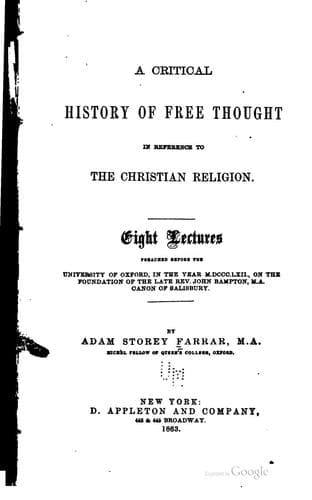
History of Free Thought in Reference to The Christian ReligionFarrar, Adam Storey
History
History of Free Thought in Reference to The Christian Religion
Farrar, Adam Storey
Free thought -- History
PERIOD I. (1750-1810).—Destructive in character, inaugurated by Semler
(pp. 218-234). PERIOD II. (1810-1835).—Reconstructive in character,
inaugurated by Schleiermacher (pp. 239-261). PERIOD III. (1835 to present
time)—Exhibiting definite and final tendencies, inaugurated by Strauss
(Lect. VII).
PERIOD I. (1750-1810), is studied under two Sub-periods:
Sub-period I. (1750-1790, pp. 219-228), which includes three movements;
(1) Within the church (p. 219 seq.); dogmatic; literary in Michaelis and
Ernesti; and freethinking in Semler (pp. 221-224), the author of the
historic method of interpretation. (2) External to the church (pp.
224-226); literary deism in Lessing, and in the Wolfenbüttel fragments of
Reimarus (p. 225). (3) External to the church; practical deism, in the
educational institutions of Basedow (p. 227).
Sub-period II. (1790-1810, pp. 227-234); the difference caused by the
introduction of two new influences; viz,
(α) The literary, of the court of Weimar and of the great men gathered
there (p. 228). (β) The philosophy of Kant, (the effect of which is
explained, pp. 229, 230); the home of both of which was at Jena.
As the result of these new influences, three movements are visible in the
Church (p. 230); viz,
(1) The critical “rationalism” of Eichhorn and Paulus, the intellectual
successors of Semler (pp. 231, 232). (2) The dogmatic, more or less
varying from orthodoxy, seen towards the end of this period in
Bretschneider, Röhr, and Wegscheider (pp. 233, 234). (3) The
supernaturalism of Reinhardt and Storr (p. 231).
PERIOD II. (1810-1835.)—Introduction of four new influences (p. 235),
which completely altered the theological tone; viz. (α) New systems of
speculative philosophy; of Jacobi, who followed out the _material_ element
of Kant’s philosophy (p. 235); and of Fichte, Schelling, and Hegel, who
followed out the _formal_ (p. 238). (β) The “romantic” school of poetry
(p. 239). (γ) The moral tone, generated by the liberation wars of 1813.
(p. 240.) (δ) The excitement caused by the theses of Harms at the
tercentenary of the Reformation in 1817. (pp. 240, 241.)
The result of these is seen (p. 241) in
(1) An improved doctrinal school under Schleiermacher (pp. 241-250),
(description of his _Glaubenslehre_, p. 245 seq.); and under his
successors, Neander, &c. (pp. 250-252.) (2) An improved critical tone (p.
252 seq.) as seen in De Wette and Ewald, which is illustrated by an
explanation of the Pentateuch controversy (pp. 254-258).
Concluding notice of two other movements to be treated in the next lecture
(p. 259); viz.
(1) an attempt, different from that of Schleiermacher, in the school of
Hegel, to find a new philosophical basis for Christianity; and (2) the
return to the biblical orthodoxy of the Lutheran church.
Remarks on the benevolence of Providence in overruling free inquiry to the
discovery of truth. (pp. 259-261).
Lecture VII.
Public-domain text, read in full here on John Shaqi.
Reviews
Reviews
No reviews yet
Be the first to share your thoughts on this work.
Join the Discussion
Join the discussion
Sign in to leave a comment or review.
Sign InorCreate an account