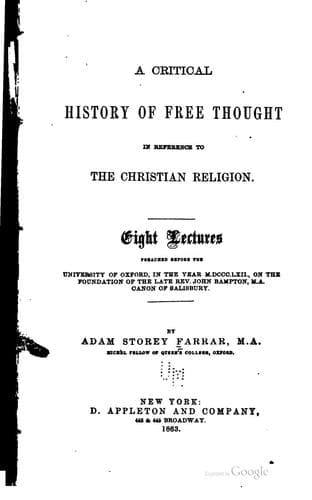
History of Free Thought in Reference to The Christian ReligionFarrar, Adam Storey
History
History of Free Thought in Reference to The Christian Religion
Farrar, Adam Storey
Free thought -- History
_Free Thought in Germany subsequently to 1835; and in France during the
present century._
FREE THOUGHT IN GERMANY (continued).—History of the transition from Period
II. named in the last lecture, to Period III. (pp. 262-274.)
Explanation of the attempt, noticed pp. 242, 259, of the Hegelian school
to find a philosophy of Christianity. Critical remarks on Hegel’s system,
(pp. 263-267-267); its tendency to create an “ideological” spirit in
religion (p. 264):—the school which it at first formed is seen best in
Marheinecke. (p. 265.)
The circumstance which created an epoch in German theology was the
publication of Strauss’s _Leben Jesu_ in 1835 (p. 266). Description of it
(α) in its critical aspect (pp. 267, 270), which leads to an explanation
of the previous discussions in Germany concerning the origin and
credibility of the Gospels (pp. 268, 269); and (β) in its philosophical,
as related to Hegel (p. 270); together with an analysis of the work (p.
271). Statement of the effects produced by it on the various theological
parties. (pp. 272, 273.)
PERIOD III. As the result of the agitation caused by Strauss’s work, four
theological tendencies are seen; viz.
(1) One external to the church, thoroughly antichristian, as in Bruno
Bauer, Feuerbach, and Stirner. (pp. 274-276.) (2) The historico-critical
school of Tübingen, founded by Chr. Bauer. (pp. 277-279.) (3) The
“mediation” school, seen in Dorner and Rothe, (pp. 279-282.) (4) A return
to the Lutheran orthodoxy, (pp. 282-285,) at first partly created by an
attempt to unite the Lutheran and Reformed churches, (p. 282); seen in the
“Neo-Lutheranism” of Hengstenberg and Hävernick, (p. 282), and the
“Hyper-Lutheranism” of Stahl and the younger members of the school. (pp.
283, 285.)
Mention of the contemporaneous increase of spiritual life in Germany. (p.
285.)
Concluding estimate of the whole movement, (pp. 286, 287); and lessons for
students in reference to it. (pp. 288, 289.)
FREE THOUGHT IN FRANCE during the present century (pp. 290-305),
(continued from Lect. IV. p. 194.)
In its tone it is constructive of belief, if compared with that of the
eighteenth century.
From 1800-1852.
The speculative thought has exhibited four distinct forms. (p. 290.)
(1) The ideology of De Tracy, in the early part of the century. (2) The
theological school of De Maistre, &c. to re-establish the dogmatic
authority of the Romish church. (3) Socialist philosophy, St. Simon,
Fourier, Comte. (4) The Eclectic school (Cousin, &c.)
Remarks on the first school.—The recovery of French philosophy and thought
from the ideas of this school, partly due to the literary tone of
Chateaubriand. (pp. 290, 291.)
Influence of the Revolution of 1830 in giving a stimulus to thought. (p.
291.)
Remarks on the third school.—Explanation of socialism as taught by St.
Simon (pp. 292, 293); as taught by Fourier (pp. 293, 294); and difference
from English socialism. (p. 294.)
Public-domain text, read in full here on John Shaqi.
Reviews
Reviews
No reviews yet
Be the first to share your thoughts on this work.
Join the Discussion
Join the discussion
Sign in to leave a comment or review.
Sign InorCreate an account