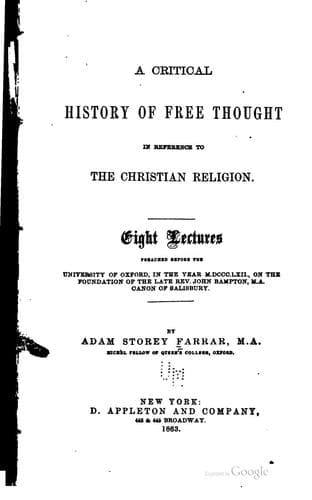
History of Free Thought in Reference to The Christian Religion — John Shaqi
History of Free Thought in Reference to The Christian ReligionFarrar, Adam Storey
History
History of Free Thought in Reference to The Christian Religion
Farrar, Adam Storey
Free thought -- History
Positivism, both as an offshoot of the last school, and in itself as a
religion and a philosophy. (pp. 295, 296.)
Remarks on the fourth school.—Eclecticism as taught by Cousin, viewed as a
philosophy and a religion. (pp. 297-299.)
Remarks on the second school; viewed as an attempt to refute the preceding
schools. (p. 300.)
From 1852-1862.
New form of eclecticism under the empire (p. 302), viz. the historic
method, based on Hegel, as Cousin’s was based on Schelling.—E. Renan the
type. (pp. 302-304.)
Free thought in the Protestant church (pp. 304, 305) regarded as an
attempt to meet by concession doubts of contemporaries.
Lecture VIII.
_Free Thought in England in the present century: Summary of the Course of
Lectures: and Inferences in reference to present dangers and duties._
MODERN UNBELIEF IN ENGLAND (continued from Lect V.):—Introductory remarks
on the alteration of its tone. (pp. 306, 307.)—The cause of which is
stated to be a general one, the subjective tone created (p. 308) by such
influences as, (1) the modern poetry (p. 309), and (2) the two great
attempts by Bentham and Coleridge to reconstruct philosophy. (pp. 309,
310.)
The doubt and unbelief treated in the following order (p. 311):
(1) That which appeals to Sensational experience and to Physical science
as the test of truth; viz. (α) Positivism among the educated (p. 312). (β)
Secularism or Naturalism among the masses (p. 313); and in a minor degree,
(γ) The doubts created by Physical science (p. 314). (2) That which
appeals to the faculty of Intuition (p. 315);—expressed in literature, by
Carlyle, (pp. 316, 317); and by the American, Emerson. (p. 317.) Influence
also of the modern literature of romance, (p. 318.) (3) Direct attacks on
Christianity, critical rather than philosophical: viz. (α) The examination
of the historic problem of the development of religious ideas among the
Hebrews, by R. W. Mackay (pp. 319, 320). (β) A summary of objections to
revelation, by Mr. Greg, _The Creed of Christendom_ (p. 321). (γ) The
examination of the psychical origin of religion and Christianity, by Miss
S. Hennell, _Thoughts in aid of Faith_, (p. 323.) (4) The deism, and
appeal to the Intuitional consciousness, expressed by Mr. Theodore Parker
(pp. 325, 326), and Mr. F. Newman (pp. 326-329). (5) The traces of free
thought within the Christian church (p. 330); viz.: (α) The philosophical
tendency which originates with Coleridge. (pp. 330-333.) (β) The critical
tendency, investigating the facts of revelation. (pp. 334-336.) (γ) The
critical tendency, the literature which contains it. (pp. 336, 337.)
This completes the history of the fourth crisis of faith (p. 339), the
history of which began near the end of Lect. III. at p. 105.
SUMMARY of the course of lectures. (pp. 339-41.)—Recapitulation of the
original purpose, which is stated to have been, while assuming the potency
of the moral, to analyse the intellectual causes of doubt, which have been
generally left uninvestigated.
Public-domain text, read in full here on John Shaqi.
Reviews
Reviews
No reviews yet
Be the first to share your thoughts on this work.
Join the Discussion
Join the discussion
Sign in to leave a comment or review.
Sign InorCreate an account