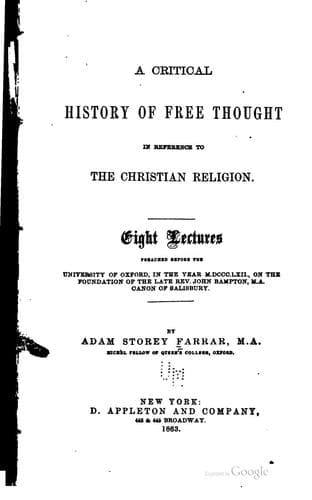
History of Free Thought in Reference to The Christian ReligionFarrar, Adam Storey
History
History of Free Thought in Reference to The Christian Religion
Farrar, Adam Storey
Free thought -- History
Refutation of objections which might be made; such as
(1) One directed against the utility of the inquiry. (p. 342.) (2) One
directed against its uncontroversial character.
A critical history shown to be useful in the present age, (1) in an
educational point of view for those who are to be clergymen, and to
encounter current forms of doubt by word or by writing (pp. 342-345); and
(2) in a controversial point of view, by resolving the intellectual
element in many cases of unbelief into incorrect metaphysical philosophy;
the value of which inquiry is real, even if such intellectual causes be
regarded only as the conditions, and not the causes, of unbelief. (p.
345.)
-------------------------------------
Further objections anticipated and refuted in reference (3) to the candour
of the mode of inquiry, and the absence of vituperation which is stated
not to be due to indifference to Christian truth, but wholly to the
demands of a scientific mode of treatment (p. 346); (4) to the absence of
an eager advocacy of any particular metaphysical theory; which is due to
the circumstance that the purpose was to exhibit errors as logical
corollaries from certain theories, without assuming the necessary
existence of these corollaries in actual life (p. 347); (5) to the
insufficiency of the causes enumerated to produce doubt without taking
account of the moral causes; which objection is not only admitted, but
shown to be at once the peculiar property which belongs to the analysis of
intellectual phenomena, and also a witness to the instinctive conviction
that the ultimate cause of belief and unbelief is moral, not intellectual;
which had been constantly assumed. (p. 347.)
-------------------------------------
THE LESSONS derived from the whole historical survey. (p. 348 seq.)
I. What has been the office of doubt in history? (p. 348.)
Opposite opinions on this subject stated. (p. 348.) Examination of the
ordinary Christian opinion on the one hand, which regards it as a mischief
(p. 348), and of Mr. Buckle’s on the other, which regards it as a good.
(p. 349.)
1. The office is shown to be, to bring all truths to the test. (p. 349.)
Historical instances of its value in destroying the Roman catholic errors.
(p. 350.)
2. Free inquiry also shown in some cases to be forced on man by the
presentation of new knowledge, which demands consideration. (p. 350.)
Denial of the statement that the doubts thus created are an entire
imitation of older doubt. (p. 352.)
3. The office of it in the hands of Providence to elicit truth by the very
controversies which it creates (p. 352); the responsibility of the
inquirer not being destroyed, but the overruling providence of God made
visible. (p. 353.)
II. What does the history teach, as to the doubts most likely to present
themselves at this time, and the best modes of meeting them? (p. 353.)
The materials shown to be presented for a final answer to these questions.
(p. 354.)
Public-domain text, read in full here on John Shaqi.
Reviews
Reviews
No reviews yet
Be the first to share your thoughts on this work.
Join the Discussion
Join the discussion
Sign in to leave a comment or review.
Sign InorCreate an account