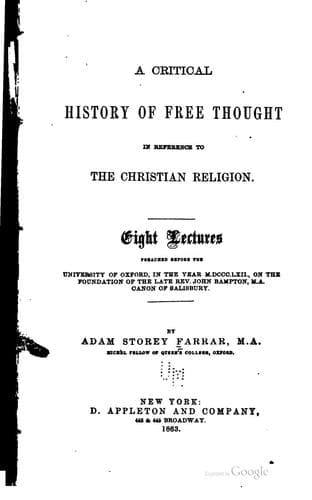
History of Free Thought in Reference to The Christian ReligionFarrar, Adam Storey
History
History of Free Thought in Reference to The Christian Religion
Farrar, Adam Storey
Free thought -- History
A history of free thought seems to point especially to the study of the
latter class. A biographical history of free thinkers would imply the
former; the investigation of the moral history of the individuals, the
play of their will and feelings and character; but the history of free
thought points to that which has been the product of their characters, the
doctrines which they have taught. Science however no less than piety would
decline entirely to separate the two;(14) piety, because, though admitting
the possibility that a judgment may be formed in the abstract on free
thought, it would feel itself constantly drawn into the inquiry of the
moral responsibility of the freethinker in judging of the concrete
cases;—science, because, even in an intellectual point of view, the
analysis of a work of art is defective if it be studied apart from the
personality of the mental and moral character of the artist who produces
it. If even the inquiry be restricted to the analysis of intellectual
causes, a biographic treatment of the subject, which would allow for the
existence of the emotional, would be requisite.(15)
The province of the following work accordingly is, the examination of this
neglected branch in the analysis of unbelief. While admitting most fully
and unhesitatingly the operation of emotional causes, and the absolute
necessity, scientific as well as practical, of allowing for their
operation, it is proposed to analyse the forms of doubt or unbelief in
reference mainly to the intellectual element which has entered into them,
and the discovery of the intellectual causes which have produced or
modified them. Thus the history, while not ceasing to belong to church
history, becomes also a chapter in the history of philosophy, a page in
the history of the human mind.
The enumeration of the causes into which the intellectual elements of
doubt are resolvable, is furnished in the text of the first Lecture.(16)
If the nature of some of them be obscure, and the reader be unaccustomed
to the philosophical study necessary for fully understanding them;
information must be sought in the books to which references are elsewhere
given, as the subject is too large to be developed in the limited space of
this Preface.
Public-domain text, read in full here on John Shaqi.
Reviews
Reviews
No reviews yet
Be the first to share your thoughts on this work.
Join the Discussion
Join the discussion
Sign in to leave a comment or review.
Sign InorCreate an account