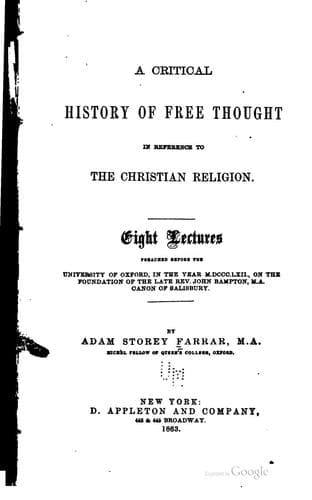
History of Free Thought in Reference to The Christian ReligionFarrar, Adam Storey
History
History of Free Thought in Reference to The Christian Religion
Farrar, Adam Storey
Free thought -- History
The work however professes to be not merely a narrative, but a “critical
history.” The idea of criticism in a history imparts to it an ethical
aspect. For criticism does not rest content with ideas, viewed as facts,
but as realities. It seeks to pass above the relative, and attain the
absolute; to determine either what is right or what is true. It may make
this determination by means of two different standards. It may be either
independent or dogmatic;—independent if it enters upon a new field
candidly and without prepossessions, and rests content with the inferences
which the study suggests;—dogmatic, when it approaches a subject with
views derived from other sources, and pronounces on right or wrong, truth
or falsehood, by reference to them.
It is hoped that the reader will not be unduly prejudiced, if the
confession be frankly made, that the criticism in these Lectures is of the
latter kind. This indeed might be expected from their very character. The
Bampton Lecture is an establishment for producing apologetic treatises.
The authors are supposed to assume the truth of Christianity, and to seek
to repel attacks upon it. They are defenders, not investigators. The
reader has a right to demand fairness, but not independence; truth in the
facts, but not hesitation in the inferences. While however the writer of
these Lectures takes a definite line in the controversy, and one not
adopted professionally, but with cordial assent and heartfelt conviction,
he has nevertheless considered that it is due to the cause of scientific
truth to intermingle his own opinions as little as possible with the facts
of the history. A history without inferences is ethically and religiously
worthless: it is a chronicle, not a philosophical narrative. But a history
distorted to suit the inferences is not only worthless, but harmful. It is
for the reader to judge how far the author has succeeded in the result:
but his aim has been not to allow his opinions to warp his view of the
facts. History ought to be written with the same spirit of cold analysis
which belongs to science. Caricature must not be substituted for portrait,
nor vituperation for description.(17)
Public-domain text, read in full here on John Shaqi.
Reviews
Reviews
No reviews yet
Be the first to share your thoughts on this work.
Join the Discussion
Join the discussion
Sign in to leave a comment or review.
Sign InorCreate an account