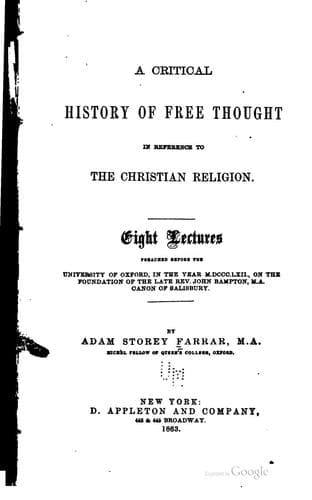
History of Free Thought in Reference to The Christian ReligionFarrar, Adam Storey
History
History of Free Thought in Reference to The Christian Religion
Farrar, Adam Storey
Free thought -- History
Such a mode of treatment in the present instance was the more possible,
from the circumstance that the writer, when studying the subject for his
private information, without any design to write upon it, had endeavoured
to bring his own principles and views perpetually to the test; and to
reconsider them candidly by the light of the new suggestions which were
brought before him. Instead of approaching the inquiry with a spirit of
hostility, he had investigated it as a student, not as a partisan. It may
perhaps be permitted him without egotism to explain the causes which led
him to the study. He had taken holy orders, cordially and heartily
believing the truths taught by the church of which he is privileged to be
an humble minister. Before doing so, he had read thoughtfully the great
works of evidences of the last century, and knew directly or indirectly
the character of the deist doubts against which they were directed. His
own faith was one of the head as well as the heart; founded on the study
of the evidences, as well as on the religious training of early years. But
he perceived in the English church earnest men who held a different view;
and, on becoming acquainted with contemporary theology, he found the
theological literature of a whole people, the Germans, constructed on
another basis; a literature which was acknowledged to be so full of
learning, that contemporary English writers of theology not only
perpetually referred to it, but largely borrowed their materials from
German sources. He wished therefore fully to understand the character of
these new forms of doubt, and the causes which had produced them. He may
confess that, reposing on the affirmative verities of the Christian faith,
as gathered from the scriptures and embodied in the immemorial teaching of
Christ’s church, he did not anticipate that he should discover that which
would overthrow or even materially modify his own faith; but he wished,
while exploring this field, and gratifying intellectual curiosity, to
re-examine his opinions at each point by the light of those with which he
might meet in the inquiry. The serious wish also to fulfill his duty in
the sphere in which he might move, made him desire to understand these new
views; that if false, he might know how to refute them when they came
before him, and not be first made aware of their existence from the harsh
satire of sceptical critics. His own studies were accordingly conducted in
a spirit of fairness—the fairness of the inquirer, not of the doubter; and
a habit of mind formed by the study of the history of philosophy, was
brought to bear upon the investigation of this chapter in church history:
first, of modern forms of doubt, and afterwards the consecutive history of
unbelief generally. Accordingly, while he hopes that he has taken care to
leave the student in no case unguided, who may accompany him in these
pages through the history, he has wished to place him, as he strove to
Public-domain text, read in full here on John Shaqi.
Reviews
Reviews
No reviews yet
Be the first to share your thoughts on this work.
Join the Discussion
Join the discussion
Sign in to leave a comment or review.
Sign InorCreate an account