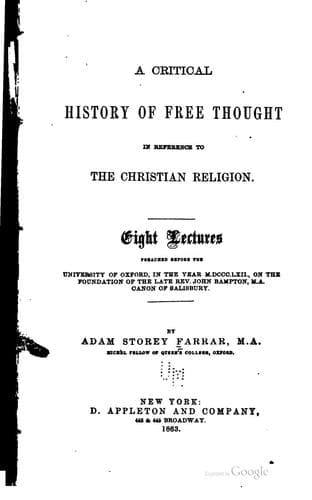
History of Free Thought in Reference to The Christian Religion — John Shaqi
History of Free Thought in Reference to The Christian ReligionFarrar, Adam Storey
History
History of Free Thought in Reference to The Christian Religion
Farrar, Adam Storey
Free thought -- History
place himself, in the position to see the subject in its true light before
drawing the inferences; to understand each topic to a certain extent, as
it appears when seen from the opposite point of view, as well as when seen
from the Christian. And when this has been effected, he has criticised
each by a comparison with those principles which form his standard for
testing them, the truth of which the study has confirmed to the writer’s
own mind. The criticism therefore does not profess to be independent, but
dogmatic; but it is hoped that the definite character of the results will
not be found to have prevented fairness in the method of inquiry. If the
student has the facts correctly, he can form his own judgment on the
inferences.
The standard of truth here adopted, as the point of view in criticism, is
the teaching of Scripture as expressed in the dogmatic teaching of the
creeds of the church; or, if it will facilitate clearness to be more
definite, three great truths may be specified, which present themselves to
the writer’s mind as the very foundation of the Christian religion: (1)
the doctrine of the reality of the vicarious atonement provided by the
passion of our blessed Lord; (2) the supernatural and miraculous character
of the religious revelation in the book of God; and (3) the direct
operation of the Holy Ghost in converting and communing with the human
soul. Lacking the first of these, Christianity appears to him to be a
religion without a system of redemption; lacking the second, a doctrine
without authority; lacking the third, a system of ethics without spiritual
power. These three principles accordingly are the measure, by agreement
with which the truth and falsehood of systems of free thought are
ultimately tested.(18)
The above remarks, together with those which occur in the text, where
fuller explanation is afforded, will illustrate the province of the
inquiry, and the spirit in which it is conducted.(19)
Public-domain text, read in full here on John Shaqi.
Reviews
Reviews
No reviews yet
Be the first to share your thoughts on this work.
Join the Discussion
Join the discussion
Sign in to leave a comment or review.
Sign InorCreate an account