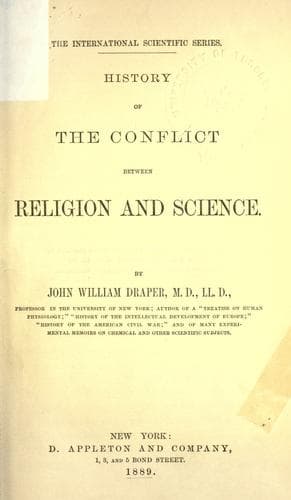
History of the Conflict Between Religion and ScienceDraper, John William
Religion
History of the Conflict Between Religion and Science
Draper, John William
Religion and science -- History
Not with equal rapidity did all classes of the population adopt
monotheistic views. The merchants and lawyers and soldiers, who by the
nature of their pursuits are more familiar with the vicissitudes of
life, and have larger intellectual views, were the first to be affected,
the land laborers and farmers the last.
THE RISE OF CHRISTIANITY When the empire in a military and political
sense had reached its culmination, in a religious and social aspect
it had attained its height of immorality. It had become thoroughly
epicurean; its maxim was, that life should be made a feast, that
virtue is only the seasoning of pleasure, and temperance the means of
prolonging it. Dining-rooms glittering with gold and incrusted with
gems, slaves in superb apparel, the fascinations of female society where
all the women were dissolute, magnificent baths, theatres, gladiators,
such were the objects of Roman desire. The conquerors of the world had
discovered that the only thing worth worshiping is Force. By it all
things might be secured, all that toil and trade had laboriously
obtained. The confiscation of goods and lands, the taxation of
provinces, were the reward of successful warfare; and the emperor
was the symbol of force. There was a social splendor, but it was the
phosphorescent corruption of the ancient Mediterranean world.
In one of the Eastern provinces, Syria, some persons in very humble
life had associated themselves together for benevolent and religious
purposes. The doctrines they held were in harmony with that sentiment
of universal brotherhood arising from the coalescence of the conquered
kingdoms. They were doctrines inculcated by Jesus.
The Jewish people at that time entertained a belief, founded on old
traditions, that a deliverer would arise among them, who would restore
them to their ancient splendor. The disciples of Jesus regarded him
as this long-expected Messiah. But the priesthood, believing that the
doctrines he taught were prejudicial to their interests, denounced
him to the Roman governor, who, to satisfy their clamors, reluctantly
delivered him over to death.
His doctrines of benevolence and human brotherhood outlasted that
event. The disciples, instead of scattering, organized. They associated
themselves on a principle of communism, each throwing into the common
stock whatever property he possessed, and all his gains. The widows
and orphans of the community were thus supported, the poor and the sick
sustained. From this germ was developed a new, and as the events proved,
all-powerful society--the Church; new, for nothing of the kind had
existed in antiquity; powerful, for the local churches, at first
isolated, soon began to confederate for their common interest. Through
this organization Christianity achieved all her political triumphs.
Public-domain text, read in full here on John Shaqi.
Reviews
Reviews
No reviews yet
Be the first to share your thoughts on this work.
Join the Discussion
Join the discussion
Sign in to leave a comment or review.
Sign InorCreate an account