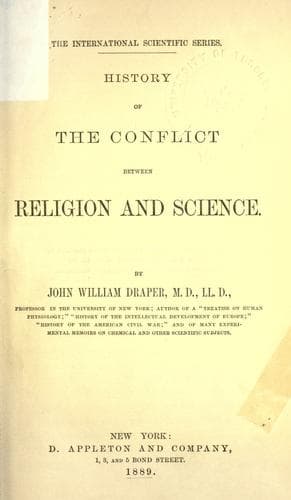
History of the Conflict Between Religion and Science — John Shaqi
History of the Conflict Between Religion and ScienceDraper, John William
Religion
History of the Conflict Between Religion and Science
Draper, John William
Religion and science -- History
As we have said, the military domination of Rome had brought about
universal peace, and had generated a sentiment of brotherhood among the
vanquished nations. Things were, therefore, propitious for the rapid
diffusion of the newly-established--the Christian--principle
throughout the empire. It spread from Syria through all Asia Minor,
and successively reached Cyprus, Greece, Italy, eventually extending
westward as far as Gaul and Britain.
Its propagation was hastened by missionaries who made it known in all
directions. None of the ancient classical philosophies had ever taken
advantage of such a means.
Political conditions determined the boundaries of the new religion. Its
limits were eventually those of the Roman Empire; Rome, doubtfully the
place of death of Peter, not Jerusalem, indisputably the place of the
death of our Savior, became the religious capital. It was better to have
possession of the imperial seven hilled city, than of Gethsemane and
Calvary with all their holy souvenirs.
IT GATHERS POLITICAL POWER. For many years Christianity manifested
itself as a system enjoining three things--toward God veneration, in
personal life purity, in social life benevolence. In its early days of
feebleness it made proselytes only by persuasion, but, as it increased
in numbers and influence, it began to exhibit political tendencies, a
disposition to form a government within the government, an empire within
the empire. These tendencies it has never since lost. They are, in
truth, the logical result of its development. The Roman emperors,
discovering that it was absolutely incompatible with the imperial
system, tried to put it down by force. This was in accordance with the
spirit of their military maxims, which had no other means but force for
the establishment of conformity.
In the winter A.D. 302-'3, the Christian soldiers in some of the legions
refused to join in the time-honored solemnities for propitiating the
gods. The mutiny spread so quickly, the emergency became so pressing,
that the Emperor Diocletian was compelled to hold a council for the
purpose of determining what should be done. The difficulty of the
position may perhaps be appreciated when it is understood that the wife
and the daughter of Diocletian himself were Christians. He was a man
of great capacity and large political views; he recognized in the
opposition that must be made to the new party a political necessity,
yet he expressly enjoined that there should be no bloodshed. But who can
control an infuriated civil commotion? The church of Nicomedia was razed
to the ground; in retaliation the imperial palace was set on fire, an
edict was openly insulted and torn down. The Christian officers in the
army were cashiered; in all directions, martyrdoms and massacres were
taking place. So resistless was the march of events, that not even the
emperor himself could stop the persecution.
Public-domain text, read in full here on John Shaqi.
Reviews
Reviews
No reviews yet
Be the first to share your thoughts on this work.
Join the Discussion
Join the discussion
Sign in to leave a comment or review.
Sign InorCreate an account