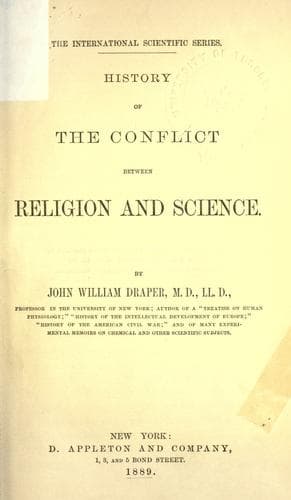
History of the Conflict Between Religion and ScienceDraper, John William
Religion
History of the Conflict Between Religion and Science
Draper, John William
Religion and science -- History
THE FIRST CHRISTIAN EMPEROR. It had now become evident that the
Christians constituted a powerful party in the state, animated with
indignation at the atrocities they had suffered, and determined to
endure them no longer. After the abdication of Diocletian (A.D. 305),
Constantine, one of the competitors for the purple, perceiving the
advantages that would accrue to him from such a policy, put himself
forth as the head of the Christian party. This gave him, in every part
of the empire, men and women ready to encounter fire and sword in his
behalf; it gave him unwavering adherents in every legion of the armies.
In a decisive battle, near the Milvian bridge, victory crowned his
schemes. The death of Maximin, and subsequently that of Licinius,
removed all obstacles. He ascended the throne of the Caesars--the first
Christian emperor.
Place, profit, power--these were in view of whoever now joined the
conquering sect. Crowds of worldly persons, who cared nothing about its
religious ideas, became its warmest supporters. Pagans at heart, their
influence was soon manifested in the paganization of Christianity that
forthwith ensued. The emperor, no better than they, did nothing to check
their proceedings. But he did not personally conform to the ceremonial
requirements of the Church until the close of his evil life, A.D. 337.
TERTULLIAN'S EXPOSITION OF CHRISTIANITY. That we may clearly appreciate
the modifications now impressed on Christianity--modifications which
eventually brought it in conflict with science--we must have, as a
means of comparison, a statement of what it was in its purer days.
Such, fortunately, we find in the "Apology or Defense of the Christians
against the Accusations of the Gentiles," written by Tertullian, at
Rome, during the persecution of Severus. He addressed it, not to the
emperor, but to the magistrates who sat in judgment on the accused. It
is a solemn and most earnest expostulation, setting forth all that could
be said in explanation of the subject, a representation of the belief
and cause of the Christians made in the imperial city in the face of the
whole world, not a querulous or passionate ecclesiastical appeal, but
a grave historical document. It has ever been looked upon as one of the
ablest of the early Christian works. Its date is about A.D. 200.
Public-domain text, read in full here on John Shaqi.
Reviews
Reviews
No reviews yet
Be the first to share your thoughts on this work.
Join the Discussion
Join the discussion
Sign in to leave a comment or review.
Sign InorCreate an account