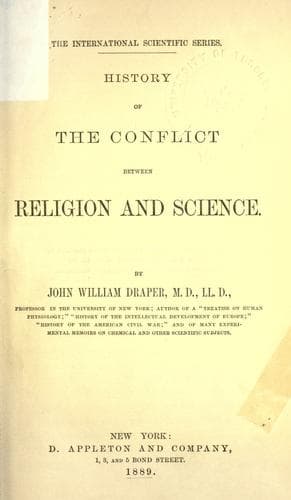
History of the Conflict Between Religion and ScienceDraper, John William
Religion
History of the Conflict Between Religion and Science
Draper, John William
Religion and science -- History
This political event was followed by the restoration of science, the
establishment of colleges, schools, libraries, throughout the dominions
of the Arabians. Those conquerors, pressing forward rapidly in their
intellectual development, rejected the anthropomorphic ideas of the
nature of God remaining in their popular belief, and accepted other more
philosophical ones, akin to those that had long previously been attained
to in India. The result of this was a second conflict, that respecting
the nature of the soul. Under the designation of Averroism, there came
into prominence the theories of Emanation and Absorption. At the
close of the middle ages the Inquisition succeeded in excluding those
doctrines from Europe, and now the Vatican Council has formally and
solemnly anathematized them.
Meantime, through the cultivation of astronomy, geography, and other
sciences, correct views had been gained as to the position and relations
of the earth, and as to the structure of the world; and since Religion,
resting itself on what was assumed to be the proper interpretation
of the Scriptures, insisted that the earth is the central and most
important part of the universe, a third conflict broke out. In this
Galileo led the way on the part of Science. Its issue was the overthrow
of the Church on the question in dispute. Subsequently a subordinate
controversy arose respecting the age of the world, the Church insisting
that it is only about six thousand years old. In this she was again
overthrown The light of history and of science had been gradually
spreading over Europe. In the sixteenth century the prestige of Roman
Christianity was greatly diminished by the intellectual reverses it
had experienced, and also by its political and moral condition. It was
clearly seen by many pious men that Religion was not accountable for
the false position in which she was found, but that the misfortune was
directly traceable to the alliance she had of old contracted with Roman
paganism. The obvious remedy, therefore, was a return to primitive
purity. Thus arose the fourth conflict, known to us as the
Reformation--the second or Northern Reformation. The special form it
assumed was a contest respecting the standard or criterion of
truth, whether it is to be found in the Church or in the Bible. The
determination of this involved a settlement of the rights of reason, or
intellectual freedom. Luther, who is the conspicuous man of the epoch,
carried into effect his intention with no inconsiderable success; and at
the close of the struggle it was found that Northern Europe was lost to
Roman Christianity.
Public-domain text, read in full here on John Shaqi.
Reviews
Reviews
No reviews yet
Be the first to share your thoughts on this work.
Join the Discussion
Join the discussion
Sign in to leave a comment or review.
Sign InorCreate an account