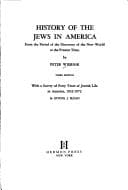
History of the Jews in America: From the Period of the Discovery of the New World to the Present Time — John Shaqi
History of the Jews in America: From the Period of the Discovery of the New World to the Present TimeWiernik, Peter
History
History of the Jews in America: From the Period of the Discovery of the New World to the Present Time
Wiernik, Peter
Jews -- America -- History; Jews -- United States -- History
The prosperity of those who remained in Curaçao went on increasing in
the eighteenth century. A benevolent society was established in 1715;
five years later they responded liberally to an appeal for aid from
the Congregation Shearith Israel of New York, and in 1756 met with
an equal generosity a similar appeal from the Jews of Newport. By
1750 their numbers had increased to about two thousand. They were
prosperous merchants and traders, and held positions of prominence in
the commercial and political affairs of the island. By the end of the
century they owned a considerable part of the property in the district
of Willemsted; and as many as fifty-three vessels are said to have
left in one day for Holland, laden with goods which for the most part
belonged to Jewish merchants.
A new congregation, which called itself “Neweh Shalom” and occupied
a tract across the harbor from Willemsted, was organized about 1740,
and its Synagogue in the “Otrabanda” was consecrated on Ellul 12,
5505 (1745). It was established chiefly in order to save those who
lived there from crossing the water on the Sabbath to attend divine
services, and for a time it was regarded as merely a branch of the
older congregation and as under its direction. This led to a series of
disputes which culminated, in 1749, in an open breach. It was settled
by the intervention of Prince William Charles of Orange-Nassau, in
a decree dated April 30, 1750, in which the original jurisdiction of
the older congregation, subject to the regulations of the Portuguese
community of Amsterdam, was sustained. The arrangement lasted for the
following one hundred and twenty years, when the younger congregation
became independent (1870).
The increase in numbers and material well-being continued during
the nineteenth century, but the community was not without internal
dissensions. It was due to one of these controversies between the
Parnassim and the ministers that a society called the “Porvenir” was
founded in 1862. In the following year it developed into a Reform
Congregation under the name “Emanuel,” whose new Synagogue, in the
quarter “Scharlo,” was dedicated in 1866. About three years before
a moderate change in the direction of reform was introduced into the
liturgy of the oldest congregation.
The congregations of Curaçao now have more than one thousand members,
nearly four-fifths of it belonging to Mickweh Israel. The Jews are
among the leading citizens of the island, in business, as well as in
the professions; they occupy executive and judicial positions, and
are well represented among the officers of the militia. Almost all of
them, like in Holland itself, are true to their religion, and there
are probably less apostasies and intermarriages than in any other free
community in which the emancipation of the Jews has been fully carried
out in theory as well as in practice.
* * * * *
Public-domain text, read in full here on John Shaqi.
Reviews
Reviews
No reviews yet
Be the first to share your thoughts on this work.
Join the Discussion
Join the discussion
Sign in to leave a comment or review.
Sign InorCreate an account